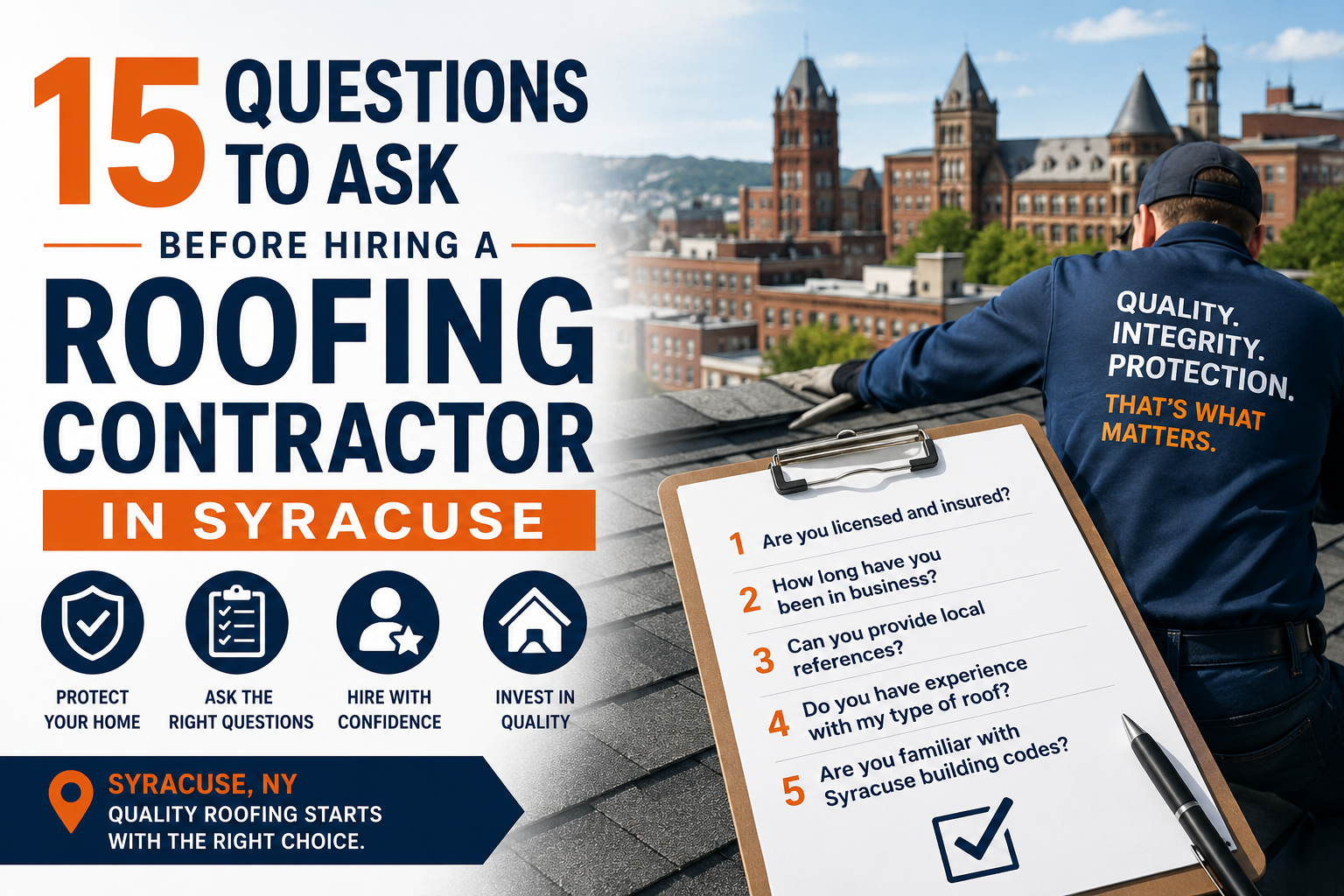
15 Questions to Ask Before Hiring a Roofing Contractor in Syracuse

By Wilson Gualan, Founder — Roofing Quality Plus Construction Corp | Syracuse, NY GAF Certified Contractor · BBB Accredited · 15+ Years Serving Central New York

Before hiring any roofing contractor in Syracuse, NY, ask these 15 questions: (1) Are you licensed and insured in New York State? (2) Can you provide proof of workers’ compensation? (3) Are you a manufacturer-certified contractor? (4) How long have you operated locally in Syracuse? (5) Can you provide local references? (6) Do you offer a written labor warranty? (7) Will you provide a written, itemized estimate? (8) What materials will you use — exact brand, product line, and warranty class? (9) Who supervises the job on-site? (10) How do you handle unexpected damage discovered during work? (11) What does your cleanup process include? (12) Do you handle insurance claims? (13) What is your payment structure? (14) How long will the project take? (15) Will you pull the required permits? A contractor who answers all 15 clearly and in writing is one you can trust.

Syracuse is one of the most demanding roofing markets in the United States. With an average of 127 inches of annual snowfall, frequent freeze-thaw cycles, summer hailstorms, and a climate that tests every material in every season — roofing work done incorrectly here fails faster, causes more interior damage, and costs more to fix than in milder markets.

Every summer, the surge in roofing demand brings two types of contractors to Central New York: the experienced, accountable professionals who have been serving this community for years, and the opportunists — undercapitalized operations, storm chasers, and inexperienced crews looking to capitalize on seasonal volume. The difference between the two is not always obvious from a business card or a website. It is revealed through the answers to the right questions.

My name is Wilson Gualan. I founded Roofing Quality Plus Construction Corp and have been roofing in the Syracuse area for over 15 years. In that time, I have inspected and repaired the aftermath of bad roofing work from contractors who disappeared after cashing checks, left incomplete flashing installations, used substandard materials, and failed to pull permits — leaving homeowners with voidable warranties, failed inspections, and thousands of dollars in remediation costs.

This guide gives you the exact questions I would ask if I were hiring a roofing contractor for my own home — and what the right answers look like.

Question 1: Are you licensed to perform roofing work in New York State?

Why it matters: New York State requires roofing contractors to hold appropriate licensing to perform and contract work legally. Licensing requirements vary by municipality — the City of Syracuse, Onondaga County, and surrounding townships each have specific requirements. An unlicensed contractor leaves you exposed to liability and may void your homeowner’s insurance coverage if a claim arises from work they performed.

The right answer: A clear, immediate yes — followed by the license number and the jurisdictions it covers. A legitimate contractor has this information readily available because they deal with it on every permit application.

Red flag: Hesitation, vague answers about “being registered,” or claims that licensing “isn’t required for this type of work.”

Question 2: Can you provide a current certificate of insurance — including general liability and workers’ compensation?

Why it matters: This is the single most important document you should request before signing any contract. General liability insurance covers damage to your property caused during the job. Workers’ compensation insurance covers any worker injured on your property. Without workers’ compensation, you — the homeowner — may be held personally liable for medical costs and lost wages if a worker falls from your roof.

In a state with roofing fatality and injury rates as high as New York’s, this is not a theoretical risk. It is a real one that plays out in court cases across the state every year.

The right answer: An immediate offer to provide a certificate of insurance naming you as an additional insured, with no expiration date pressure and clear coverage limits. A legitimate contractor will proactively offer to send this document before you ask for it.

Red flag: Any contractor who cannot produce a current certificate of insurance within 24 hours, who claims their insurance “is in the truck,” or who asks you to trust their word on coverage.

Question 3: Are you a manufacturer-certified contractor — and which warranties can you offer in writing?

Why it matters: Manufacturer certification programs — particularly the GAF Certified Contractor program — require contractors to demonstrate verified installation expertise, maintain adequate insurance, and commit to ongoing professional development. Certified contractors can offer enhanced warranty packages, including extended material and workmanship warranties, that uncertified contractors cannot access regardless of the promises they make verbally.

As a GAF Certified Contractor, Roofing Quality Plus Construction Corp can offer the GAF System Plus warranty — including a 25-year color warranty against fading or discoloration and an optional 50-year extended coverage warranty. An uncertified contractor cannot offer these warranties even if they purchase and install the same GAF products.

The right answer: Confirmation of current manufacturer certification, the specific certifying manufacturer, and a written description of which warranty tiers they can offer on your project.

Red flag: A contractor who claims to install “premium materials” but cannot name a specific manufacturer certification or offer enhanced warranty documentation in writing.

Question 4: How long have you been operating in the Syracuse area — and can you show me a verifiable local business address?

Why it matters: A contractor’s longevity and local presence are among the strongest predictors of accountability and quality. A company that has operated in the Syracuse area for 10 or more years has a local reputation to protect — and local customers who can speak to their work. A contractor who arrived this season has nothing at stake if the job goes wrong.

Storm chasers — contractors who follow severe weather events from market to market — are a recognized industry problem. They appear in force after significant hail or wind events, move quickly to sign contracts, and frequently disappear before warranty issues arise. Their business model depends on volume and speed, not quality or accountability.

The right answer: A specific number of years operating locally, a verifiable physical address (not a P.O. box), and the ability to point to a Google Business profile with a significant history of local reviews.

Red flag: Vague answers about “being in the area,” a P.O. box address, no verifiable Google presence, or a company that cannot name the specific neighborhoods they have worked in across Central New York.

Question 5: Can you provide three references from recent jobs in the Syracuse area — and may I contact them directly?

Why it matters: A confident, quality contractor will have no hesitation providing references from recent local customers. More importantly, the willingness to provide references — and the quality of those references when you call them — tells you far more than any marketing material or online profile.

When you call references, ask specifically: Was the project completed on time and on budget? Was the crew professional and did they clean up thoroughly? Did the contractor communicate clearly throughout? Have you had any issues since the project was completed, and if so, how did the contractor respond?

The right answer: Three or more references provided without hesitation, with names and phone numbers you can actually call.

Red flag: A contractor who offers written testimonials instead of live references, who says references are “available upon request” but then delays providing them, or whose references cannot speak to recent work in the Syracuse area.

Question 6: What is your labor warranty — and what exactly does it cover in writing?

Why it matters: A roofing material warranty covers the product against defects. It does not cover installation errors — and installation errors are the leading cause of roof failures in Central New York. The vast majority of leaks, flashing failures, and premature shingle failures we diagnose trace back to how the roof was installed, not to the materials themselves.

A labor warranty is your protection against the contractor’s own workmanship. It says they stand behind how the work was done — not just what it was done with.

At Roofing Quality Plus Construction Corp, every project carries a 10-year labor warranty. This means if any installation-related issue arises within 10 years of our work, we come back and address it at no charge to you.

The right answer: A specific warranty period (not vague promises), a written description of what is and is not covered, and clarity on what process you follow to invoke the warranty if needed.

Red flag: A contractor who offers only a one-year labor warranty, who cannot describe the warranty terms clearly, or who gives a warranty verbally but will not put it in writing.

Question 7: Will you provide a written, itemized estimate before any work begins?

Why it matters: A handshake agreement or a single-line quote is not a contract — it is an invitation for misunderstanding, scope creep, and disputes. Before a single shingle is lifted on your property, you should have a written document that specifies exactly what work will be done, with what materials, to what standard, on what timeline, and at what total cost.

The right answer: Yes — immediately and without negotiation. The estimate should include: scope of work (tear-off vs. overlay, which sections are being addressed), material specifications (manufacturer, product line, color, warranty class), underlayment specifications, ice-and-water shield coverage zones, flashing details, ventilation work if applicable, disposal of old materials, project start date and estimated completion, payment schedule, and warranty terms.

Red flag: A contractor who provides a verbal quote and asks you to “trust the number,” who gives a vague written estimate without material specifications, or who adds language like “plus materials as needed” without defining what that means.

Question 8: What specific materials will you use — including manufacturer, product line, and warranty class?

Why it matters: Not all asphalt shingles are created equal. The difference between a builder-grade shingle and a premium architectural shingle can mean 8 to 12 years of additional lifespan in Syracuse’s climate. Some contractors quote “30-year shingles” and install the cheapest product that technically carries a 30-year warranty — a warranty that requires specific installation conditions most budget contractors do not meet.

The right answer: Specific, named materials. For example: “GAF Timberline HDZ architectural shingles, with GAF FeltBuster synthetic underlayment, GAF WeatherWatch ice-and-water shield at the eaves and valleys, and GAF Seal-A-Ridge cap shingles.” A contractor who knows their craft knows their materials by name.

Red flag: Generic descriptions like “quality shingles” or “standard materials,” inability to name the specific manufacturer or product line, or resistance to specifying materials in writing before the contract is signed.

Question 9: Who will be on the job site supervising the installation — and will subcontractors be used?

Why it matters: Many roofing companies in the Syracuse market subcontract installation work to crews they do not directly employ or consistently supervise. The company you hire may have excellent credentials and reviews — but if the actual installation is performed by a subcontracted crew that the company has no direct quality control over, those credentials provide limited protection.

The right answer: A named project supervisor or crew lead who will be present on your job site, clear information about whether subcontractors are used and how their work is supervised, and accountability that the company takes direct responsibility for the installation quality regardless of who performs it.

Red flag: Vague answers about who will actually be on the roof, acknowledgment that subcontractors are used without clear explanation of how quality is supervised, or a company representative who cannot name the specific crew lead for your job.

Question 10: How do you handle unexpected damage discovered during the project — and will you notify me before proceeding with additional work?

Why it matters: Roofing projects frequently uncover issues that were not visible during the initial estimate — decking rot, deteriorated insulation, structural damage from ice dams, pest infiltration. How a contractor handles these discoveries tells you a great deal about their integrity and their respect for your budget.

The right answer: A clear process: the contractor stops work, documents the unexpected damage with photographs, presents you with a written change order describing the additional scope and cost, and waits for your explicit approval before proceeding. No legitimate contractor adds scope or cost to a project without documented authorization from the homeowner.

Red flag: A contractor who describes a vague “we’ll handle whatever we find” approach, who mentions additional charges only after the work is complete, or who has no formal change order process.

Question 11: What does your cleanup process include — specifically for nails and fasteners?

Why it matters: A roofing project generates hundreds — sometimes thousands — of loose fasteners. A nail embedded in a car tire or stepped on by a child in bare feet is a real consequence of inadequate cleanup. Professional roofing contractors use magnetic nail sweepers (rolled over the yard and driveway multiple times) and perform a systematic job-site walkdown before leaving your property.

The right answer: A description of the specific cleanup process: debris removed from the roof and contained, a minimum of two passes with a magnetic nail sweeper across all yard and driveway areas, removal of all packaging and waste materials, and a final walkthrough with you before the crew leaves.

Red flag: A contractor who gives a vague assurance that “they always clean up” without describing specific process, or who cannot explain what tools they use for fastener collection.

Question 12: Do you handle insurance claims — and do you work with public adjusters?

Why it matters: This question separates roofing companies that are true full-service partners from those that simply install shingles. If your roof has been damaged by wind, hail, or wildlife, your homeowner’s insurance may cover 100 percent of the repair or replacement cost — and you only pay your deductible.

Many homeowners don’t pursue legitimate insurance claims because they fear the process, fear premium increases, or simply don’t know they’re entitled to coverage. A roofing contractor who handles the claims process on your behalf — working directly with your insurance company and partnering with licensed public adjusters who specialize in negotiating maximum settlements — delivers dramatically more value than one who only shows up after the check is cut.

At Roofing Quality Plus Construction Corp, we guide homeowners through the entire insurance claims process. We document the damage, work directly with your insurance adjuster, and partner with licensed public adjusters to ensure you receive every dollar your policy entitles you to. Covered damage includes wind, storm, hail, and wildlife damage to roofing, siding, and gutters. Importantly, under applicable New York law, weather-related damage claims do not affect your policy’s value or premium.

The right answer: Yes — a full description of how they handle claims, who they partner with, and what their process looks like from inspection through settlement.

Red flag: A contractor who has no claims experience, who tells you to “handle the insurance side yourself,” or who is unfamiliar with public adjusters.

Question 13: What is your payment structure — and do you require a large deposit?

Why it matters: Payment terms reveal risk posture. A professional contractor has established supplier relationships and access to materials credit — they do not need a large percentage of your total contract price before work begins. A contractor who demands 50 percent or more upfront is either financially unstable, planning to use your deposit to fund another job, or — in the worst cases — planning to disappear.

The right answer: A deposit of 10 to 30 percent to secure scheduling and materials, with the balance due upon completion and your satisfaction. Some larger commercial projects may have milestone-based payment schedules, which are legitimate — but the final payment should always occur after the work is complete and you have conducted a walkthrough.

Red flag: Cash-only payment requirements, requests for more than 30 to 40 percent upfront, requests for full payment before work begins, or pressure to pay quickly without a written contract in place.

Question 14: What is the realistic project timeline — including start date, completion date, and any weather-contingency plan?

Why it matters: Vague timelines create frustration and are a sign of poor project management. A professional contractor schedules work in advance, communicates clearly about start dates, and has a defined process for handling weather delays — which are inevitable in Central New York.

The right answer: A specific start date, a realistic completion window based on the scope of work, and a clear explanation of what happens if weather delays the project — including how you will be notified and how the schedule adjusts.

Red flag: Contractors who say they can “start immediately” without a clear explanation of how your job fits into their existing schedule, or who give a completion date that seems unrealistically fast given the scope of work.

Question 15: Will you pull all required permits for this project?

Why it matters: In the City of Syracuse and across Onondaga County, roofing permits are required for full replacements and significant structural repairs. Permits exist to protect homeowners — they trigger inspections that verify the work was done to code, they create a public record of the work for future home sales, and they ensure your homeowner’s insurance coverage remains valid.

Some contractors suggest skipping permits to save time or money. This is never in your interest as a homeowner. An unpermitted roof replacement can create complications when you sell the home, may void your homeowner’s insurance coverage on that structure, and leaves you with no code-compliance verification.

The right answer: Yes — an unequivocal commitment to pull all required permits for your project, including familiarity with the specific permit requirements for your municipality in the Syracuse area.

Red flag: Any suggestion that permits are unnecessary, optional, or can be “handled later,” or a contractor who frames permit skipping as a cost-saving benefit to you.

The Contractor Evaluation Scorecard

Use this simple scorecard when evaluating contractors in Syracuse. A legitimate, professional roofing contractor should answer yes to all 15 questions — clearly, completely, and in writing.

Question

Must answer YES

Verified in writing

Licensed in NY State

Proof of insurance (GL + WC)

Manufacturer certified

5+ years local operation

Local references provided

Written labor warranty (5+ years)

Written itemized estimate

Specific materials named

Named on-site supervisor

Change order process defined

Specific cleanup process

Handles insurance claims

Deposit ≤30% of total

Specific project timeline

Pulls required permits

Any contractor who cannot answer yes to every item on this list — or who answers yes verbally but resists putting it in writing — is a contractor worth reconsidering.

Red Flags That Should End the Conversation Immediately

Beyond the 15 questions, certain behaviors should end your engagement with a contractor outright:

Door-to-door solicitation after storms. Legitimate roofing companies with established local reputations do not knock on doors uninvited, especially immediately after storm events. This is a defining characteristic of storm chasers.

No verifiable online presence or local reviews. A contractor operating in the Syracuse area for any meaningful period should have a Google Business profile with a history of verifiable local reviews. The absence of this is not a neutral signal — it is a warning.

Pressure to sign immediately. “This price is only good today” and “I have another job lined up” are manipulation tactics designed to prevent you from getting competitive quotes or doing due diligence. Legitimate contractors do not use them.

Reluctance to provide any document before contract signing. Insurance certificates, license numbers, references, and material specifications should be available without any hesitation. A contractor who treats these requests as obstacles is hiding something.

Offering to let you keep the insurance check. Some fraudulent contractors offer arrangements where they perform less work than was approved in your insurance claim and split the difference with you. This constitutes insurance fraud in New York State, and the homeowner — not just the contractor — faces legal liability.

Why Roofing Quality Plus Construction Corp Answers All 15 Questions

I’m sharing this guide not just as a resource for Syracuse homeowners but as a direct statement about how Roofing Quality Plus Construction Corp operates.

We are a GAF Certified Contractor — one of a select group in Central New York with verified manufacturer certification. We carry full general liability and workers’ compensation insurance on every project. We have operated continuously in the Syracuse area for 15+ years, with a verifiable local address, a documented history of local reviews, and hundreds of completed projects across Onondaga County and surrounding communities.

Every project we undertake comes with a written, itemized estimate; a named on-site supervisor; specific material specifications; a formal change order process; magnetic nail sweep cleanup; and a 10-year labor warranty backed in writing. We pull required permits. We handle insurance claims from inspection through settlement, partnering with licensed public adjusters to ensure our clients receive full coverage.

We answer yes to all 15 questions — and we put every answer in writing.

The most important question is whether they carry current workers’ compensation insurance — and whether they can provide a certificate of insurance immediately. If a worker is injured on your property and the contractor lacks workers’ comp, you may face personal liability for medical costs. This is the non-negotiable first screen for any roofing contractor you consider hiring in New York State.

You can verify contractor licensing through the New York State Department of Labor website and through the City of Syracuse’s Department of Neighborhood and Business Development for city-specific licenses. Additionally, request the contractor’s license number in writing and verify it yourself before signing any contract.

A roofing contract in New York should include: full scope of work, specific materials with manufacturer and product names, warranty terms for both materials and labor, payment schedule, project timeline, permit responsibilities, change order process, and cleanup commitments. New York State consumer protection law requires home improvement contractors to provide written contracts for work exceeding $500.

A reasonable roofing deposit in the Syracuse market is 10 to 30 percent of the total project cost. This secures your scheduling slot and covers initial material procurement. Any request for more than 30 to 40 percent upfront — and especially any request for full payment before work begins — should be treated as a significant warning sign.

Yes. The City of Syracuse and Onondaga County require permits for full roof replacements and significant structural repairs. Your contractor should pull the permit as part of the project — not suggest skipping it. Unpermitted work can create complications at home sale, void insurance coverage, and leave you without code-compliance verification.

GAF maintains a certified contractor locator at gaf.com where you can search by zip code. Roofing Quality Plus Construction Corp is a GAF Certified Contractor serving the greater Syracuse area. GAF Certified contractors can be identified by their certification documentation and their ability to offer GAF’s enhanced warranty tiers, including the System Plus and Golden Pledge warranties.

A public adjuster is a licensed professional who represents the homeowner — not the insurance company — in negotiating an insurance settlement. They specialize in maximizing the payout on legitimate claims, particularly for storm, wind, hail, and wildlife damage. In New York, public adjusters are licensed by the Department of Financial Services. Roofing Quality Plus partners with licensed public adjusters to ensure our clients receive full coverage on qualifying insurance claims.

Most residential roof replacements in Syracuse take one to three days depending on home size, roof complexity, and weather conditions. Roofing Quality Plus completes the majority of standard single-family home replacements in one to two days, including full cleanup. Commercial projects and complex multi-section roofs may require additional time.

Ask specifically: Do you use a magnetic nail sweeper, and how many passes do you make? How do you contain and remove old shingle debris? Do you do a final walkthrough with the homeowner before the crew leaves? A contractor with a professional cleanup process will describe it specifically. Vague assurances that they “always clean up” are not sufficient.

Yes. Roofing Quality Plus guides homeowners through the entire insurance claims process — from initial damage documentation through insurance company coordination and final settlement. We partner with licensed public adjusters to ensure our clients receive full coverage for wind, hail, storm, and wildlife damage to roofing, siding, and gutters. Under applicable New York law, weather-related damage claims do not affect your policy’s value or premium. Call us at (315) 775-9205 for a free damage assessment.

Get a Free Consultation With Syracuse’s Most Trusted GAF Certified Roofer

If you are currently evaluating roofing contractors in Syracuse and want to see exactly how Roofing Quality Plus Construction Corp answers these 15 questions — in person, in writing, and without pressure — we invite you to schedule a free consultation and roof assessment.

Wilson Gualan and his team have served the Syracuse community for 15+ years. We will answer every question on this list completely and in writing, provide a detailed itemized estimate at no cost, and give you an honest recommendation — whether the right answer is a minor repair, a targeted maintenance plan, or a full replacement.

📞 Call or text: +1 (315) 775-9205 

Roofing Quality Plus Construction Corp is a GAF Certified contractor and BBB-accredited business founded by Wilson Gualan, proudly serving Syracuse, NY and surrounding Central New York communities for 15+ years. Services include residential and commercial roofing installation, repair, replacement, guttering, siding, and complete insurance claim guidance.
What Is a GAF Certified Roofing Contractor and Why Does It Matter?

By Wilson Gualan, Founder — Roofing Quality Plus Construction Corp | Syracuse, NY GAF Certified Contractor · BBB Accredited · 15+ Years Serving Central New York

If you’ve started researching roofers for an upcoming project, you’ve probably come across the phrase “GAF Certified Roofing Contractor” more than once. It shows up on websites, business cards, and Google listings — but most homeowners don’t actually know what it means or why it should influence their hiring decision. This guide breaks down exactly what a GAF Certified Roofing Contractor is, how the certification works, why it matters, and how to use it to make a smarter, safer hiring decision for your home or business.

A GAF Certified Roofing Contractor is a roofing company that has been officially vetted and approved by GAF, the largest roofing manufacturer in North America. GAF produces some of the most widely used roofing materials in the country, including asphalt shingles, underlayment, ventilation systems, and complete roofing systems. Because so much rides on proper installation, GAF created a certification program to identify contractors who consistently meet high standards of training, licensing, and customer service.

GAF does not hand out this certification to just anyone. To become a GAF Certified Roofing Contractor, a company must meet strict requirements, including:


Holding proper state licensing and active insurance coverage

Maintaining a strong track record of customer satisfaction and reviews

Employing trained, factory-certified installation crews

Following GAF’s manufacturer-approved installation standards and best practices

Passing ongoing performance reviews and periodic requalification

Because GAF puts its own brand reputation on the line every time it certifies a contractor, the bar for certification is intentionally high. Only a small percentage of roofing companies in the United States qualify for this status at any given time, which is part of why the certification carries weight with homeowners, insurers, and real estate professionals alike.

A Brief History of the GAF Certification Program

GAF has been manufacturing roofing materials since 1886, making it one of the oldest and most established names in the industry. As the roofing market grew more competitive and homeowners struggled to differentiate between skilled contractors and inexperienced ones, GAF introduced its certification program to formalize a standard of quality. Over time, this evolved into a tiered system that rewards contractors for training, professionalism, and consistent customer satisfaction — giving homeowners an easier way to identify trustworthy roofing companies without having to evaluate every contractor from scratch.

Why Does a GAF Certified Roofing Contractor Matter?

Hiring a GAF Certified Roofing Contractor matters because it directly affects the quality of your installation, the warranty protection available to you, and your overall peace of mind throughout the project. Here’s why the certification carries real weight in practical terms:

1. Stronger, Manufacturer-Backed Warranties

Standard roofing warranties typically cover materials only, leaving homeowners exposed if a contractor makes an installation error. A GAF Certified Roofing Contractor can offer enhanced warranty options — including extended workmanship coverage — because GAF trusts these crews to install products correctly the first time. This means both materials and labor can be protected under one comprehensive warranty, rather than forcing you to rely on a separate, often weaker, contractor-issued guarantee.

2. Verified Training and Installation Standards

Roofing failures are rarely caused by bad shingles; they’re usually caused by improper installation. A GAF Certified Roofing Contractor has proven, factory-level training on proper techniques, ventilation requirements, flashing details, and system compatibility. This reduces the risk of leaks, premature wear, ice damming, or voided warranties down the road — problems that are far more common with contractors who lack formal manufacturer training.

3. Accountability and Ongoing Review

GAF regularly monitors certified contractors for customer complaints, license status, and insurance compliance. If a contractor fails to maintain these standards, GAF can revoke their certification. This gives homeowners an added layer of accountability that unlicensed or uncertified roofers simply don’t offer, since there’s no manufacturer standing behind their work quality.

4. Higher Resale and Insurance Value

Roofs installed by a GAF Certified Roofing Contractor with a documented manufacturer warranty are often viewed more favorably by home insurers and prospective buyers. A transferable warranty can be a meaningful selling point if you list your home in the future, and some insurers factor certified installations into their underwriting or premium calculations.

5. Access to Premium Product Lines and Extended Warranties

Some of GAF’s top-tier warranty programs — such as the Golden Pledge Limited Warranty — are only available when installed by a GAF Master Elite Contractor, a higher tier within the certification program. This means homeowners who hire a certified contractor may have access to protection levels that simply aren’t available through non-certified companies, regardless of how much they’re willing to pay.

6. Reduced Risk of Contractor Fraud

Roofing is, unfortunately, an industry where fraudulent or fly-by-night contractors are common, especially after storms. Because GAF Certified Roofing Contractors must maintain active licensing, insurance, and a physical business presence to keep their certification, hiring one significantly reduces the risk of dealing with a contractor who disappears mid-project or performs substandard work with no recourse.

How to Verify a Roofing Company’s GAF Certification

Before hiring any roofer who claims to be GAF certified, it’s worth confirming it yourself rather than taking their word for it. Here’s how:

  • Ask for their GAF certification number or their official GAF contractor profile link
  • Search GAF’s official contractor directory directly on gaf.com
  • Confirm the certification tier (Certified, Master Elite, or President’s Club)
  • Check that their state license and general liability/workers’ comp insurance are current
  • Read verified reviews on their GAF profile page, not just third-party sites

A legitimate GAF Certified Roofing Contractor will have no problem providing this information upfront, and reputable companies often display their certification badge directly on their website along with a link to their GAF profile.

GAF Certification Tiers Explained

Not all “GAF certified” claims mean the same thing. GAF offers several certification levels, each with different requirements and warranty benefits:

  • Certified Contractor — Meets GAF’s baseline requirements for licensing, insurance, and training. This is the entry-level tier of certification.
  • Master Elite Contractor — A more exclusive tier, reserved for roughly the top 3% of roofing contractors nationwide, based on reputation, licensing, craftsmanship, and financial stability. Only Master Elite Contractors can offer certain premium warranties.
  • President’s Club — An even smaller, invitation-only group recognized for outstanding customer service and business practices, representing the highest honor GAF gives to residential roofing contractors.

When comparing quotes from different roofing companies, it’s worth asking which tier a contractor actually holds, since the requirements — and the warranty benefits available to you — differ significantly between levels. A contractor who says “we’re GAF certified” without specifying a tier may only hold the baseline certification, which comes with fewer warranty options than Master Elite status.

Common Myths About GAF Certification

There are a few misconceptions worth clearing up:

Myth: Any contractor who installs GAF shingles is “GAF certified.” Installing GAF products does not automatically make a contractor certified. Certification requires a formal application and approval process through GAF directly.

Myth: GAF certification means the contractor is the cheapest option. Certification is not related to pricing. It reflects training, accountability, and warranty eligibility — not cost. In fact, some certified contractors price competitively because reduced callback and warranty-claim risk allows them to operate more efficiently.

Myth: All GAF certifications are the same. As covered above, there are multiple tiers, and the difference between a baseline Certified Contractor and a Master Elite Contractor can be significant in terms of warranty access and vetting rigor.

What to Ask a GAF Certified Roofing Contractor Before Hiring

Even after confirming certification, it’s worth asking a few additional questions to ensure a good fit for your project:

  • Which GAF warranty options are you eligible to offer, and what do they cover?
  • Can you provide references from recent GAF-certified installations in my area?
  • How long have you held your current certification tier?
  • What is your process for ventilation and flashing details, since these are common failure points?
  • Do you handle the manufacturer warranty registration on my behalf?

A contractor who can answer these clearly and confidently is typically a strong indicator of genuine expertise, not just a marketing claim.

Why Local Climate Makes This Certification Even More Important

In regions that experience harsh winters, heavy snow loads, ice damming, and significant temperature swings, proper roofing installation is even more critical than in milder climates. Improper ventilation or flashing work can lead to ice dams, attic moisture problems, and premature shingle failure much faster in cold-weather regions than in areas with more moderate conditions. This makes hiring a contractor with verified, manufacturer-level training — rather than someone who learned informally on the job — an especially important safeguard for homeowners in colder parts of the country.

Final Thoughts: Why This Certification Should Influence Your Decision

Choosing a GAF Certified Roofing Contractor isn’t just about a badge on a website. It’s a practical way to reduce risk on one of the largest investments you’ll make in your home. From stronger warranty coverage to verified installation training and ongoing manufacturer oversight, certification gives homeowners a level of assurance that uncertified contractors simply can’t match.

If you’re planning a roof replacement, repair, or inspection, ask any contractor you’re considering whether they are GAF certified — and don’t hesitate to verify it independently before signing a contract. The extra few minutes of due diligence can save you from years of potential headaches, disputes, and out-of-pocket repair costs.

Not necessarily. While certified contractors may price projects based on quality materials and proper installation practices, the added warranty protection and reduced risk of costly errors often make them a better long-term value, even if the upfront quote is comparable to or slightly higher than an uncertified competitor.

No certification can guarantee perfection, but a GAF Certified Roofing Contractor is held to significantly higher training and accountability standards than an uncertified contractor, which meaningfully lowers the likelihood of installation-related problems.

No. Only contractors who have applied, been vetted, and been formally approved by GAF can legally use the certification. Homeowners should always verify claims directly through GAF’s official contractor locator rather than relying on a company’s own website or sales pitch.

GAF certification is not a one-time achievement. Contractors are subject to ongoing performance monitoring, and certification can be revoked if licensing, insurance, or customer satisfaction standards are not maintained.

Yes, GAF offers certification programs for both residential and commercial roofing contractors, though the specific requirements and warranty programs differ between the two categories.

Get a Free Roof Assessment in Syracuse, NY

If your roof is approaching or past the milestones outlined in this guide — or if you simply want an honest professional opinion about where your roof stands — Roofing Quality Plus Construction Corp offers free, no-pressure inspections for Syracuse homeowners and commercial property managers.

Wilson Gualan and his team have assessed hundreds of roofs across Onondaga County and surrounding areas over 15 years. You’ll get a clear, written assessment, honest guidance on repair vs. replacement, and a detailed quote — with no obligation to proceed.

Call or text us: +1 (315) 775-9205

Roofing Quality Plus Construction Corp is a GAF Certified contractor and BBB-accredited business founded by Wilson Gualan, proudly serving Syracuse, NY and surrounding Central New York communities for 15+ years. Services include residential and commercial roofing installation, repair, replacement, guttering, siding, and insurance claim guidance.

How Long Does a Roof Last in Syracuse, NY? Lifespan Guide by Material

By Wilson Gualan, Founder — Roofing Quality Plus Construction Corp | Syracuse, NY GAF Certified Contractor · BBB Accredited · 15+ Years Serving Central New York

The short answer: In Syracuse, NY, a standard architectural asphalt shingle roof lasts 20 to 28 years with proper installation and maintenance. Metal roofing lasts 40 to 70 years. Flat commercial roofing systems last 15 to 30 years depending on the membrane type. However, Syracuse’s unique climate — including 127 inches of annual snowfall, frequent freeze-thaw cycles, and summer hailstorms — consistently shortens roof lifespans compared to national averages. Installation quality and annual maintenance are the two biggest variables within any homeowner’s control.

Before diving into material-specific lifespans, it’s important to understand why roofs in Central New York age faster than the national benchmarks you’ll see from manufacturers and roofing trade associations.

National average lifespan figures are calculated across all U.S. climates — including mild regions like the Pacific Northwest, the Southeast, and the Southwest, where roofs face far less mechanical stress. Syracuse is consistently ranked among the snowiest cities in the United States, with an average annual snowfall of 127 inches according to NOAA climate data. That snowfall, combined with the following conditions, puts exceptional stress on roofing systems year-round:


Freeze-thaw cycling. Syracuse experiences dozens of freeze-thaw cycles each winter. Water infiltrates microscopic cracks in shingles or membrane seams, freezes and expands, then thaws — widening those cracks incrementally with each cycle. Over a decade, this mechanical degradation significantly shortens effective roof lifespan.

Ice dam formation. Ice dams — ridges of ice that form along eaves when rooftop snow melts unevenly — are a near-universal challenge for Syracuse homeowners. When ice dams force meltwater back beneath shingles, the resulting water infiltration damages decking, insulation, and interior structures. Poorly ventilated or inadequately insulated roofs are especially vulnerable.

Snow load stress. At roughly 20 pounds per cubic foot for wet, dense snow, a 12-inch snowpack on a 2,000 square foot roof imposes approximately 40,000 pounds of dead load. Repeated heavy snow accumulation stresses roof decking fasteners, ridge lines, and structural supports — accelerating the physical deterioration of the roofing system overall.

UV exposure and thermal cycling in summer. Syracuse summers bring significant UV radiation that degrades asphalt binder and oxidizes roofing membranes. Daytime surface temperatures on dark asphalt shingles can reach 150 to 180 degrees Fahrenheit, while nighttime temperatures drop dramatically. This thermal cycling stresses adhesive seals and shingle granule bonding throughout the summer months.

Hailstorm frequency. Central New York experiences hailstorms regularly between June and September. Even small hail — 0.75 to 1.0 inches in diameter — can cause significant granule loss on asphalt shingles, accelerating UV degradation and reducing effective waterproofing lifespan by 3 to 7 years per significant impact event.

Understanding this climate context is essential for making accurate lifespan projections — and for understanding why the estimates in this guide differ from what you might find on a national roofing manufacturer’s website.

Architectural Asphalt Shingles — 20 to 28 Years

Architectural asphalt shingles (also called dimensional or laminated shingles) are the most common roofing material in the Syracuse market, covering the majority of single-family homes in Onondaga County and surrounding areas.

National average lifespan: 25 to 30 years Realistic Syracuse lifespan: 20 to 28 years With premium installation and maintenance: Up to 30 years

Architectural shingles are constructed with a fiberglass mat base coated in asphalt and topped with mineral granules. The granules are the shingle’s primary UV protection layer — once granule loss becomes significant, UV degradation of the asphalt accelerates rapidly, shortening remaining lifespan substantially.

What shortens asphalt shingle life in Syracuse:

  • Ice dam infiltration separating shingle adhesive strips from the course below
  • Granule loss from hail impact events
  • Thermal cycling cracking the asphalt layer during summer heat and winter cold
  • Freeze-thaw expansion widening micro-fractures over time
  • Inadequate attic ventilation allowing heat buildup that cooks the shingles from below

What maximizes asphalt shingle life in Syracuse:

  • Ice-and-water shield underlayment installed in all vulnerable zones (eaves, valleys, penetrations)
  • Proper ridge ventilation maintaining attic temperatures close to outdoor temperatures
  • Annual spring inspection to identify and address developing issues early
  • Prompt granule loss repair or localized shingle replacement after hail events
  • GAF-certified installation ensuring manufacturer specifications are met

Signs your asphalt roof is approaching end of life:

  • Curling or cupping at shingle edges across multiple roof planes
  • Widespread granule loss visible in gutters and at downspout discharge points
  • Shingles becoming brittle and cracking when touched
  • Visible daylight or discoloration in the attic decking
  • Multiple isolated leaks suggesting widespread waterproofing failure rather than isolated issues

At Roofing Quality Plus Construction Corp, the majority of our asphalt shingle replacements in the Syracuse area involve roofs between 22 and 28 years old. With proper installation and annual maintenance, the upper end of that range is consistently achievable.

    3-Tab Asphalt Shingles — 15 to 20 Years

    3-tab shingles — the thinner, flat-profile shingles common on homes built before the 1990s — have a shorter lifespan than architectural shingles due to their single-layer construction and lighter weight.

    National average lifespan: 20 to 25 years Realistic Syracuse lifespan: 15 to 20 years

    If your Syracuse home has 3-tab shingles and the roof is approaching or past 15 years, professional evaluation is strongly recommended. The combination of Syracuse’s climate stress and the inherently limited durability of 3-tab construction makes this one of the highest-risk roof types in our market.

    Metal Roofing — 40 to 70 Years

    Metal roofing is the longest-lasting residential roofing option available in the Syracuse market — and arguably the best-suited to Central New York’s climate. Its performance advantages over asphalt in cold, snowy climates are substantial.

    National average lifespan: 40 to 70 years Realistic Syracuse lifespan: 40 to 65 years With premium gauge and installation: Up to 70 years

    Types of metal roofing available in Syracuse:

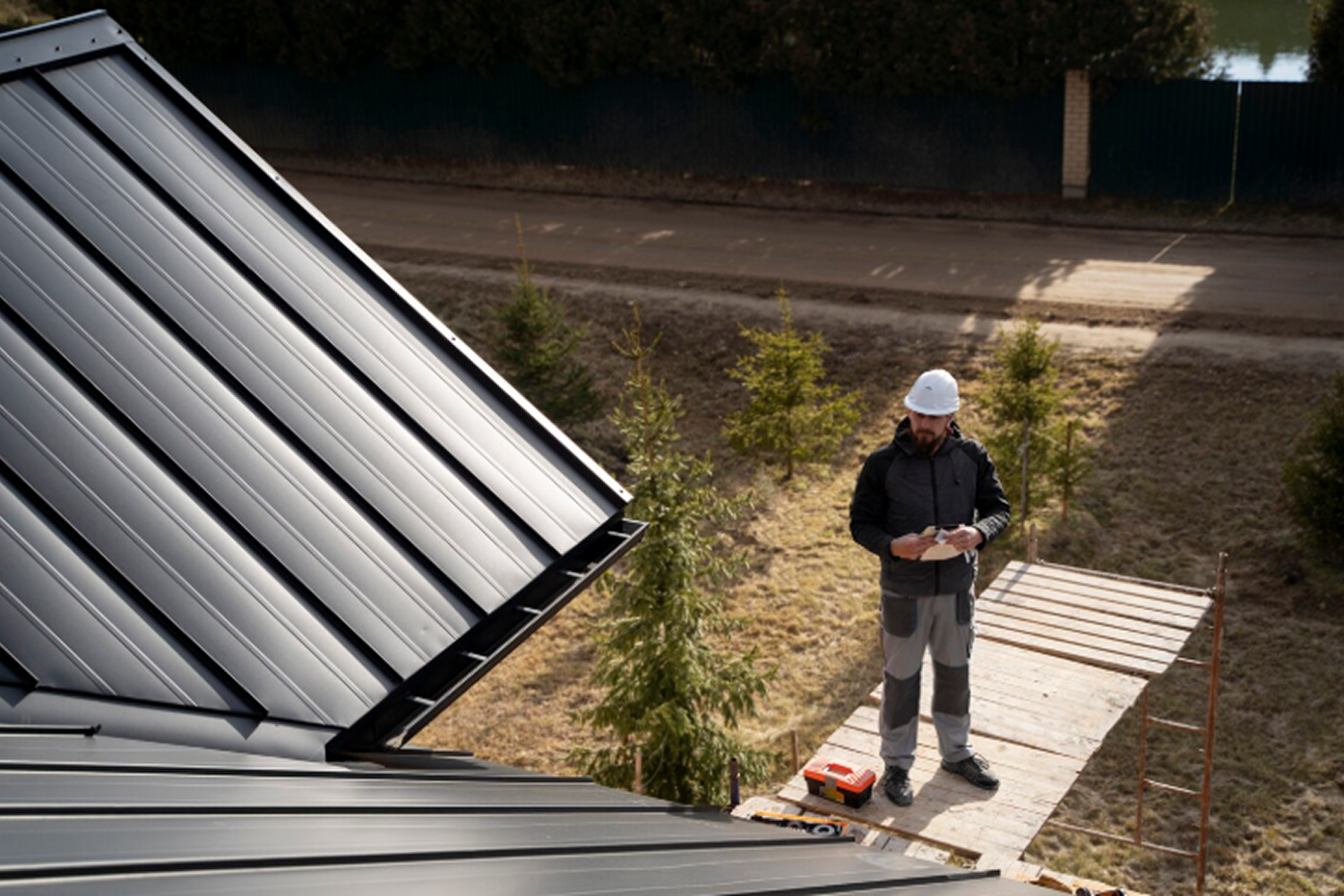
    Standing seam metal roofing (40 to 70 year lifespan) — Vertical panels with raised, interlocking seams and concealed fasteners. The gold standard of metal roofing in snowy climates. No exposed fasteners means no fastener-related leak points, and the smooth surface sheds snow naturally and rapidly.

    Metal shingles (30 to 50 year lifespan) — Steel or aluminum panels stamped to mimic the appearance of asphalt shingles, slate, or wood shake. Offers metal durability with a more traditional residential aesthetic.

    Corrugated metal panels (25 to 40 year lifespan) — More common in agricultural and commercial applications; occasionally used on residential projects.

    Why metal roofing outperforms in Syracuse specifically:

    • Snow slides off naturally, reducing ice dam risk dramatically
    • No granule layer to lose from hail impact
    • Does not crack, curl, or degrade from freeze-thaw cycling
    • Reflects summer solar heat, reducing cooling loads by 10 to 25 percent
    • Does not absorb water, eliminating freeze-expansion moisture damage
    • Resistant to mold, mildew, and insect damage

    Considerations for Syracuse metal roofing installations:

    • Higher upfront cost: $10 to $20+ per square foot installed vs. $4 to $8 for asphalt
    • Requires certified installation — improper standing seam installation is a common source of problems with metal roofing
    • Expansion and contraction with temperature changes must be accommodated through proper panel attachment systems
    • Denting from large hail is possible on thinner gauges; 24-gauge steel or heavier is recommended for Central New York

    On a cost-per-year basis, metal roofing frequently costs less than asphalt over a 40-year ownership period. A $16,000 standing seam roof lasting 50 years costs $320 per year. A $9,000 asphalt roof lasting 25 years costs $360 per year — and requires replacement once more within that same 50-year window.

    Wood Shake and Wood Shingles — 15 to 25 Years

    Wood roofing — cedar shake and cedar shingles in particular — was once common in the Syracuse market on older homes and period properties. It is increasingly rare on new installations due to maintenance demands, fire risk concerns, and the availability of superior alternatives.

    National average lifespan: 20 to 30 years Realistic Syracuse lifespan: 15 to 25 years

    Wood roofing is particularly problematic in Syracuse’s climate for several reasons:

    • Cedar absorbs moisture readily. In Syracuse’s wet winters, wood shakes cycle through repeated wetting and drying, causing expansion, contraction, splitting, and warping far faster than in drier climates.
    • Algae, moss, and lichen growth is common in Central New York’s humid conditions and significantly accelerates wood degradation.
    • Ice dam infiltration forces water into existing wood grain gaps, accelerating splitting and rot.
    • Wood roofing requires treatment with preservatives and algaecides every 3 to 5 years to achieve maximum lifespan in this climate.

    If your Syracuse home has original wood shake roofing approaching 20 years, proactive evaluation and planning for replacement is recommended. Most homeowners in this situation replace with architectural asphalt or metal for lower maintenance requirements and longer lifespan.

    Slate Roofing — 75 to 150+ Years

    Natural slate is the longest-lasting roofing material available — period. Properly installed natural slate roofing on a structurally sound roof deck can outlast the building it protects.

    National average lifespan: 75 to 150+ years Realistic Syracuse lifespan: 75 to 125+ years

    Natural slate is impervious to moisture, freeze-thaw cycling, UV degradation, and insect damage. Many homes in older Syracuse neighborhoods — Strathmore, Eastwood, and Sedgwick — still have original slate roofing installed 80 to 100 years ago that remains functionally sound.

    The critical caveat: Slate roofing is premium both in material and installation cost — typically $15 to $30+ per square foot installed. It also requires a structurally reinforced roof deck capable of bearing slate’s substantial weight (approximately 8 to 15 pounds per square foot, versus 2 to 4 pounds for asphalt). Repairs require skilled slate installers, who are increasingly rare.

    For homes with existing slate roofing in the Syracuse area, the most important maintenance consideration is the flashings and the fasteners, not the slate itself. Flashings fail long before the slate does — and a slate roof with failed flashings will leak just as aggressively as any other roof type.

    Flat Commercial Roofing Systems — 15 to 30 Years

    Commercial and flat-roof residential properties in the Syracuse area use membrane-based roofing systems rather than slope-drainage systems. Each membrane type has distinct lifespan characteristics in Central New York’s climate.

    TPO (Thermoplastic Polyolefin) membrane

    • Realistic Syracuse lifespan: 20 to 30 years
    • Heat-welded seams provide excellent waterproofing integrity
    • White reflective surface reduces summer cooling costs
    • Excellent cold-weather flexibility prevents winter cracking

    EPDM (Ethylene Propylene Diene Monomer) rubber membrane

    • Realistic Syracuse lifespan: 20 to 30 years
    • Exceptional cold-weather flexibility — remains pliable at temperatures below -40°F
    • Large sheet sizes minimize seam count and leak risk
    • Proven 50+ year track record in northern climates

    Modified Bitumen membrane

    • Realistic Syracuse lifespan: 15 to 25 years
    • Multi-layer construction provides redundancy
    • Strong puncture resistance for high-traffic roofs
    • Requires careful seam application for maximum waterproofing

    PVC (Polyvinyl Chloride) membrane

    • Realistic Syracuse lifespan: 20 to 25 years
    • Superior chemical resistance — preferred for restaurant and food service buildings
    • Heat-welded seams comparable to TPO

    The single most important factor in commercial roof lifespan in Syracuse is drainage maintenance. Flat roofs that accumulate ponding water — water standing more than 48 hours after rainfall — degrade at 3 to 5 times the rate of well-drained systems. Semi-annual drain cleaning and inspection is essential for achieving maximum membrane lifespan.

    Syracuse Roof Lifespan at a Glance

    Roofing Material

    National Average

    Realistic Syracuse Lifespan

    Key Climate Challenge

    3-Tab Asphalt Shingles

    20–25 years

    15–20 years

    Ice dams, freeze-thaw

    Architectural Asphalt

    25–30 years

    20–28 years

    Granule loss from hail, ice

    Metal (Standing Seam)

    40–70 years

    40–65 years

    Minimal — best cold-climate choice

    Metal Shingles

    30–50 years

    30–45 years

    Minor denting risk from large hail

    Wood Shake/Shingle

    20–30 years

    15–25 years

    Moisture absorption, moss growth

    Natural Slate

    75–150+ years

    75–125+ years

    Flashing failure (not slate itself)

    TPO Membrane (commercial)

    20–30 years

    20–30 years

    Ponding water, seam stress

    EPDM Membrane (commercial)

    20–30 years

    20–30 years

    Seam adhesive in extreme cold

    Modified Bitumen

    15–25 years

    15–25 years

    Seam application quality

    The Two Factors That Matter More Than Material

    Across 15 years of roofing in Central New York, two variables consistently separate roofs that reach the top of their material lifespan from those that fail 5 to 10 years early.

    1. Installation Quality

    A premium roofing material installed incorrectly will underperform a standard material installed with precision and care. The most common installation failures we see when assessing older Syracuse roofs include:

    Inadequate ice-and-water shield coverage. New York State building code requires ice-and-water shield at the eaves, but best practice in Syracuse calls for coverage in valleys, around all penetrations, and along rake edges as well. Contractors who install only the code minimum leave significant ice dam vulnerability.

    Improper attic ventilation. Balanced attic ventilation — intake at the soffits, exhaust at the ridge — is critical for roofing longevity in cold climates. Inadequate ventilation allows heat to build up under the roof deck in summer (cooking shingles from below) and allows moisture to accumulate in winter (promoting decking rot and mold). Many roofs we assess have insufficient ventilation that has been shortening their lifespan since day one.

    Incorrect fastener placement. Each shingle manufacturer specifies a nailing zone — typically a narrow band across the shingle. Fasteners above this zone (high nailing) dramatically reduce wind uplift resistance and adhesive strip engagement. In Syracuse, where winter winds regularly exceed 30 to 40 mph, improperly fastened shingles are lost far sooner than correctly installed ones.

    Inadequate flashing installation. Flashings at chimneys, valleys, skylights, and pipe penetrations are the most common source of roof leaks — but they’re also the most commonly shortchanged element in budget installations. Proper flashing requires step flashing, counter flashing, appropriate sealants, and correct integration with the shingle courses. Improper flashing fails within a few years even on a new roof.

    This is why working with a GAF Certified Contractor like Roofing Quality Plus Construction Corp matters in practice, not just on paper. Certification requires demonstrated adherence to manufacturer installation specifications — which means the installation variables that most shorten roof lifespan are systematically controlled.

    2. Maintenance Frequency and Quality

    The difference between a 20-year asphalt roof and a 28-year asphalt roof is frequently maintenance. Specifically:

    Annual spring inspection. An inspection after every Syracuse winter identifies ice dam damage, lifted flashings, nail pops, and granule loss before they become leak sources. The cost of an inspection is trivial compared to the interior damage a missed leak causes.

    Gutter maintenance. Clogged gutters back water up against the roof edge, promoting ice dam formation and fascia rot. Gutters should be cleaned at minimum twice yearly in Syracuse — after leaf fall in October/November and after winter debris accumulation in April/May.

    Prompt minor repairs. A cracked pipe boot seal is a $150 repair. Left for one Syracuse winter, the resulting water infiltration into the attic may cause $4,000 to $8,000 in decking replacement, insulation replacement, and mold remediation. Minor repairs done promptly are among the highest-ROI investments a homeowner can make.

    Moss and algae treatment. Biological growth on roofing accelerates surface degradation. In Central New York, where shade and moisture are common, moss and algae are frequent issues — particularly on north-facing roof planes. Treatment with zinc strips or algaecide applications, combined with appropriate shingle selection (GAF’s Stain Guard shingles resist algae growth), significantly extends effective lifespan.

    When Should You Replace vs. Repair?

    This is the most common question we’re asked during inspections at Roofing Quality Plus, and the honest answer depends on several intersecting factors.

    Consider repair if:

    • Your roof is under 15 years old and damage is isolated to a specific area
    • The underlying decking is structurally sound and dry
    • The number of damaged shingles is small (fewer than 10 to 15 percent of total coverage)
    • No systemic granule loss or widespread adhesive failure is present
    • The damage has a clear, single cause (one failed pipe boot, one area of ice dam infiltration)

    Consider replacement if:

    • Your asphalt roof is 20+ years old with multiple developing issues
    • Granule loss is widespread across multiple roof planes
    • You have had more than two leak events in the past three years
    • The attic shows evidence of widespread moisture damage or mold
    • Decking rot is present in multiple areas
    • The cost of targeted repairs approaches or exceeds 30 percent of replacement cost
    • You plan to stay in the home for 10+ more years — a replacement now eliminates ongoing repair costs and the risk of major interior damage

    At Roofing Quality Plus Construction Corp, we provide free, honest assessments that give you a clear picture of where your roof stands — including our genuine recommendation for repair vs. replacement. We don’t benefit from recommending replacement when repair is the right answer, and we’ll tell you so directly.

    The most common roofing material in Syracuse — architectural asphalt shingles — lasts 20 to 28 years in Central New York’s climate. This is shorter than the national average of 25 to 30 years due to Syracuse’s heavy snowfall (127 inches annually), frequent freeze-thaw cycles, and ice dam formation. Metal roofing lasts 40 to 65 years in Syracuse; natural slate can last 75 to 125+ years with proper maintenance.

    Natural slate has the longest theoretical lifespan (75 to 125+ years) but is extremely expensive and requires structural reinforcement. For practical purposes, standing seam metal roofing (40 to 65 years) offers the best combination of longevity, cold-climate performance, and cost-effectiveness for the majority of Syracuse homeowners.

    Yes, significantly. The combination of 127 inches of average annual snowfall, dozens of freeze-thaw cycles per winter, ice dam formation, summer hailstorms, and UV exposure in summer collectively reduces roofing lifespan by 2 to 8 years compared to national averages — depending on material type and installation quality.

    Key indicators include: curling or cupping shingles across multiple roof planes, widespread granule loss visible in gutters, multiple leak events in recent years, a roof age of 20+ years for asphalt, visible daylight through the attic decking, or widespread moisture staining in the attic. A free professional inspection from a certified local contractor gives you the most reliable assessment.

    Yes — installation quality is arguably the most important variable in roof lifespan, even more than material choice. Proper ice-and-water shield coverage, correct attic ventilation, accurate fastener placement, and high-quality flashing installation can add 5 to 10 years to any roofing system’s effective lifespan in Central New York’s climate.

    Standing seam metal roofing typically lasts 40 to 65 years in Syracuse’s climate — and occasionally longer with high-quality installation and material. Metal roofing is particularly well-suited to Central New York because its smooth surface sheds snow naturally (reducing ice dam risk), it doesn’t absorb moisture, it won’t crack from freeze-thaw cycling, and it has no granule layer to lose from hail impact.

    The three most common causes of premature roof failure in the Syracuse area, in order of frequency, are: (1) ice dam water infiltration caused by inadequate ice-and-water shield or poor attic ventilation, (2) improper flashing installation at chimneys, valleys, and penetrations, and (3) deferred maintenance — minor issues left unaddressed through one or more winters until water damage has reached the decking or interior structure.

    Commercial flat roofing membranes — TPO, EPDM, and modified bitumen — typically last 15 to 30 years in Central New York depending on the system type, installation quality, and maintenance frequency. Semi-annual drain cleaning and bi-annual professional inspection are the most important maintenance factors for maximizing flat roof lifespan in Syracuse’s climate.

    Yes. A new roof is consistently one of the top-performing home improvement investments for resale value in the Syracuse market. A new asphalt shingle roof typically recoups 60 to 70 percent of its cost in added home value according to Remodeling Magazine’s Cost vs. Value Report. A metal roof often recoups a higher percentage and serves as a significant selling point with buyers who don’t want to replace a roof within their first decade of ownership.

    Roofing Quality Plus Construction Corp, founded by Wilson Gualan, is a GAF Certified and BBB-accredited roofing contractor with 15+ years of continuous operation in the Syracuse area. GAF Certification requires demonstrated installation expertise and allows access to the most comprehensive manufacturer warranties available — including the 25-year color guarantee and optional 50-year extended warranty. Every project is backed by a 10-year labor warranty. Contact us at (315) 775-9205 for a free, no-obligation roof assessment.

    Get a Free Roof Assessment in Syracuse, NY

    If your roof is approaching or past the milestones outlined in this guide — or if you simply want an honest professional opinion about where your roof stands — Roofing Quality Plus Construction Corp offers free, no-pressure inspections for Syracuse homeowners and commercial property managers.

    Wilson Gualan and his team have assessed hundreds of roofs across Onondaga County and surrounding areas over 15 years. You’ll get a clear, written assessment, honest guidance on repair vs. replacement, and a detailed quote — with no obligation to proceed.

    Call or text us: +1 (315) 775-9205

    Roofing Quality Plus Construction Corp is a GAF Certified contractor and BBB-accredited business founded by Wilson Gualan, proudly serving Syracuse, NY and surrounding Central New York communities for 15+ years. Services include residential and commercial roofing installation, repair, replacement, guttering, siding, and insurance claim guidance.

    Top-rated roofing contractor in Syracuse: what to look for this summer

    By Roofing Quality Plus Construction Corp | Syracuse, NY

    Summer is the single busiest season for roofing contractors in Central New York — and for good reason. The warmer months bring longer days, drier weather, and a wave of homeowners who’ve been putting off repairs since winter. That surge in demand also brings something else: a flood of contractors, many of whom disappear just as quickly as they arrived.

    Choosing the right roofing contractor in Syracuse isn’t just about getting the lowest quote. It’s about protecting one of your home’s most critical systems — and ensuring the work is done correctly the first time, backed by someone who will still be around if something goes wrong a year from now.

    At Roofing Quality Plus Construction Corp, we’ve been serving Syracuse homeowners for 13+ years. We’ve also seen — and fixed — the aftermath of bad roofing work from contractors who cut corners or vanished after cashing a check. This guide will walk you through exactly what to look for when hiring a roofing contractor this summer, so you don’t become one of those stories.

    Before diving into contractor selection, it helps to understand why summer matters so much for roofing — and why the hiring stakes are higher than you might expect.

    Post-winter damage becomes visible. After months of snow loads, ice dams, and freeze-thaw cycles, spring and early summer reveal the toll Syracuse winters take on roofs. Curled shingles, failed flashings, lifted ridge caps, and cracked pipe boots all show up once the snow is gone. Homeowners who’ve been waiting for warmer weather to address these issues all go to market at once.

    Longer days mean more installation capacity. Roofing contractors can complete more work per day in summer, making it the ideal season for full replacements, which may take one to three days depending on the size and complexity of the job.

    Summer storm season creates urgency. Central New York experiences significant thunderstorm and hail activity between June and September. Homeowners with existing vulnerabilities want them addressed before the next big storm.

    Contractor demand outpaces supply. Because everyone wants work done in summer, quality contractors book up fast — sometimes weeks out. This creates pressure on homeowners to make quick hiring decisions, which is exactly when mistakes happen.

    Understanding this context helps explain why having a clear framework for evaluating contractors — before you’re under pressure — is so valuable.

    1. Verifiable Local Reputation 

      A contractor’s reputation is the single most important signal of quality — and in the internet age, it’s easier than ever to verify.Start with Google. Search the company name and read the reviews carefully. Look for:


      A high volume of reviews (not just a handful), since patterns emerge across many customers.

      Recent reviews that reflect current performance, not just historical reputatio

      Specific mentions of quality, communication, cleanup, and adherence to timeline

      How the company responds to negative reviews — professionally and constructively, or defensively.

      Also check the Better Business Bureau (BBB). BBB accreditation isn’t automatic — it requires a contractor to meet standards of trustworthiness and commit to resolving disputes. Roofing Quality Plus Construction Corp is proud to be BBB-accredited, reflecting our commitment to transparent, ethical business practices.

      Don’t just read reviews — ask the contractor for references from recent jobs in the Syracuse area and actually call them. A confident, quality contractor will have no hesitation providing references.


    2. Manufacturer Certification

      Not all roofing contractors are equal even when they’re installing the same materials. Manufacturer certification programs — like the GAF Certified Contractor program — require contractors to demonstrate verified installation expertise, carry adequate insurance, and maintain a commitment to ongoing training.

      Why does this matter to you as a homeowner?

      Access to enhanced warranties. Standard roofing material warranties cover the product against defects. A GAF-certified contractor like Roofing Quality Plus can offer the GAF System Plus or Golden Pledge warranties — which cover both materials and workmanship, sometimes for 25 to 50 years. Uncertified contractors cannot offer these warranties regardless of what they promise verbally.

      Proven installation quality. Manufacturer certification isn’t just a marketing badge — it’s a third-party validation that the contractor installs products correctly according to the manufacturer’s specifications.

      Accountability. Certified contractors are held to a standard by the manufacturer. If a certified contractor does substandard work, the manufacturer relationship creates an additional layer of accountability beyond the contractor alone.

      When evaluating contractors this summer, always ask whether they hold current manufacturer certification and which warranties they can actually offer in writing.


    3. Full Licensing and Insurance — Verified, Not Assumed

      Every legitimate roofing contractor working in New York State should carry:

      General liability insurance — covering damage to your property in the event of an accident during the job. Ask for a certificate of insurance naming you as an additional insured, and verify it directly with the insurance carrier if in doubt.

      Workers’ compensation insurance — covering any workers injured on your property. This is non-negotiable. If a roofer falls from your home and the contractor doesn’t carry workers’ comp, you could be personally liable for their medical costs and lost wages. This scenario plays out more often than most homeowners realize.

      New York State contractor licensing — requirements vary by municipality, so confirm the contractor holds all applicable licenses for work in the Syracuse area.

      Never take a contractor’s word on insurance coverage. Ask for documentation and take thirty seconds to verify the policy is current and active. A legitimate contractor will hand these documents over without hesitation.


    4. A Written, Itemized Estimate

      A handshake agreement or a one-line quote is not a contract — it’s an invitation for misunderstandings and disputes. Before any work begins, you should have a written, itemized estimate that specifies:

        The exact scope of work (tear-off vs. overlay, areas being addressed)

        Material specifications — manufacturer name, product line, color, and warranty class

        Shingle thickness or weight and underlayment specifications

        Flashing details — material type and which areas are being reflashed

        Ventilation work if applicable

        Disposal of old materials

        Project timeline with start and estimated completion dates

        Payment schedule — deposit amount, milestone payments, and final payment terms

        Warranty terms for both materials and labor.


        Vague language like “replace roof as needed” or “standard materials” should be red flags. A professional contractor who knows their materials and their scope of work will have no problem putting every detail in writing.


      1. Strong Labor Warranty

        The material warranty covers the shingles or membrane — it tells you the manufacturer will replace defective materials. But materials rarely fail on their own. The vast majority of roof failures trace back to installation errors — improper flashing, inadequate fastening, wrong nail placement, missing ice-and-water shield in required zones.

        A labor warranty is your protection against installation errors. It says the contractor stands behind the quality of their own work.

        At Roofing Quality Plus Construction Corp, every project is backed by a 10-year labor warranty — one of the strongest in the Syracuse market. When evaluating other contractors, ask specifically about their labor warranty, get the terms in writing, and compare them directly.

        Be cautious of contractors who offer a one-year labor warranty or none at all. These are contractors who aren’t confident enough in their own work to stand behind it beyond the short term.


      2. Strong Labor Warranty

        Summer roofing season brings out contractors who use pricing tactics that benefit them at your expense. Watch out for:

        Unusually low initial quotes. A quote dramatically below competitors usually means corners are being cut — on materials, on installation time, on fastener spacing, or on flashing detail. Some contractors also use low initial quotes to get the job, then escalate costs mid-project through “discovered issues.”

        High-pressure sales tactics. “This price is only good for today” and “I have another job lined up and can only fit you in if you sign now” are pressure tactics designed to prevent you from getting competitive quotes. Legitimate contractors don’t operate this way.

        Large upfront deposits. A reasonable deposit is 10 to 30 percent of the project total to secure materials and scheduling. Requests for 50 percent or more upfront — especially in cash — are a serious warning sign.

        Verbal-only warranties or promises. If a contractor makes promises verbally that they won’t put in writing, those promises are worth nothing if a dispute arises.

        A trustworthy contractor will give you a clear, fair price, explain exactly what it includes, and give you time to compare. That’s the approach we take at Roofing Quality Plus — transparent pricing, written terms, and no pressure.


      3. Proper Safety Practices and a Professional Crew

        Roofing is one of the most physically demanding and high-risk construction trades. A contractor’s approach to job-site safety tells you a great deal about their overall professionalism.

        When your contractor arrives, notice whether:

        • Workers use proper fall protection equipment (harnesses and anchors) on roofs above a certain pitch

          The job site is organized and materials are staged safelyWorkers are using appropriate tools and equipment rather than improvising

          The crew appears experienced and works systematically rather than haphazardly

        A crew that cuts corners on safety is cutting corners elsewhere too. Professional contractors invest in safety because they care about their workers — and because proper safety practices produce better, more methodical work.


      4. Local Physical PresenceThis sounds basic, but it matters enormously: make sure the contractor has a verifiable local presence in the Syracuse area. This means a real physical address, not just a P.O. box. It means they’ve been operating locally for years, not just this summer. It means they have local employees and community ties.

        “Storm chasers” — contractors who follow severe weather events from city to city — are a real phenomenon in the roofing industry. They appear in force after major storms, offer quick work at attractive prices, and often disappear before any warranty issues surface. Because they have no local reputation to protect, they have little incentive to get every job right.

        Roofing Quality Plus Construction Corp has been rooted in the Syracuse community for over 13 years. Our reputation is entirely local, which means every job we do is a direct reflection of who we are as a company. We don’t have the option of moving on — and we wouldn’t want to.


      5. Clear Communication and Responsiveness

        How a contractor communicates during the estimate and sales process is a direct preview of how they’ll communicate during the job. If they’re slow to return calls, vague about scheduling, or hard to get clear answers from before you’ve signed anything — it won’t get better after you’ve signed.

        Look for a contractor who:

        • Returns calls and messages promptly
        • Gives you a clear, realistic project timeline and sticks to it
        • Keeps you informed of progress and any unexpected discoveries
        • Is available to answer your questions without making you feel rushed

        At Roofing Quality Plus, we’re available 24/7 — including for emergency services — because we understand that roofing concerns don’t keep business hours. Our team is committed to keeping you informed at every stage of your project.


      6. Post-Job Cleanup and Final Walkthrough

        A professional roofing job ends with two things that less careful contractors often skip: thorough cleanup and a final walkthrough.

        Cleanup means your property is left exactly as the crew found it — every nail, every shingle scrap, every piece of packaging removed. A magnetic nail sweeper should make at least two passes across your yard and driveway to pick up loose fasteners that could damage vehicle tires or injure bare feet.

        A final walkthrough means the project manager or crew lead walks the completed job with you, points out what was done, confirms the work matches the written scope, and answers any questions you have before they leave. This walkthrough also gives you the opportunity to review the job site and raise any concerns while the crew is still on-site to address them.

        These final steps reflect how much a contractor respects your home and their own work. Don’t settle for a crew that finishes and disappears without a word.

        Red Flags to Watch Out for This Summer

        Even knowing what to look for, it helps to have a clear list of warning signs that should make you walk away from a contractor immediately:

        Door-to-door solicitation after storms. Legitimate, reputable contractors do not knock on doors uninvited, especially after storm events.

        No verifiable local address or history. If you can’t find them on Google Maps, can’t verify a physical location, or can’t find reviews from local customers, keep looking.

        Reluctance to provide proof of insurance. Any contractor who hesitates or makes excuses when asked for a certificate of insurance is hiding something. Full stop.

        Requesting cash-only payment or full payment before work begins. These are classic signs of a contractor who intends to do poor work — or no work at all.

        No written contract or vague contract terms. You should never let work begin on your home without a signed, detailed written contract.

        Suggesting you skip a permit. For full roof replacements, permits may be required in the City of Syracuse and surrounding municipalities. A contractor who suggests skipping permits is potentially saving time at your expense — exposing you to liability and making future home sales more complicated.


        Questions to Ask Every Roofing Contractor You Interview

        Before you sign with any contractor this summer, ask these questions directly:

        • How long have you been operating in the Syracuse area?

        • Are you a licensed contractor in New York State?

        • Can you provide a current certificate of insurance for both general liability and workers’ compensation?

        • Are you manufacturer-certified, and which warranties can you offer in writing?

        • What is your labor warranty, and what exactly does it cover?

        • Will you provide a written, itemized estimate?

        • Who will be on-site supervising the job?

        • How do you handle unexpected issues discovered during the job?

        • What does your cleanup process look like?

        • Can you provide three references from recent jobs in the Syracuse area?

        A quality contractor will answer every one of these questions clearly and completely. Hesitation, deflection, or vague answers to any of them are informative.


        Why Syracuse Homeowners Choose Roofing Quality Plus Construction Corp

        We know we’re not the only roofing contractor in Syracuse — and we’ll tell you that honestly. What we will tell you is what sets us apart:

        13+ years of continuous local operation — We’re not a seasonal operation or a franchise. We’re a locally owned, community-rooted business that has been serving Syracuse homeowners and businesses for over a decade.

        GAF Certified Contractor — We’re one of a select group of Syracuse-area contractors certified by GAF, America’s largest roofing manufacturer. This certification means we can offer enhanced warranties — including the 25-year color warranty and optional 50-year extended warranty — that most contractors simply cannot.

        BBB Accreditation — We meet the Better Business Bureau’s standards for ethical, transparent business practices.

        10-Year Labor Warranty — We stand behind every installation and repair with one of the strongest labor warranties in the Central New York market.

        24/7 Availability — Roof emergencies don’t wait for business hours, and neither do we. If you have an urgent situation this summer, we’re one call away.

        Free Inspections, No Pressure — We don’t charge for roof inspections, and we don’t use high-pressure sales tactics. You get an honest assessment and a detailed quote, and the decision is entirely yours.


        Late spring through early fall — roughly May through October — offers the best conditions for roof replacement in Central New York. Summer is ideal for scheduling because dry weather and long days allow for efficient, high-quality installation. Booking early in the season is recommended, as quality contractors fill their summer calendars quickly.

        Most residential roof replacements in Syracuse take one to three days depending on the home’s size, roof complexity, and whether tear-off is required. Roofing Quality Plus completes the majority of standard residential replacements in one to two days, with full cleanup included.

        We recommend getting at least three quotes from local, established contractors. Compare them not just on price but on materials specified, warranty terms, and the contractor’s credentials. The lowest bid is rarely the best value — focus on what you’re actually getting for the price.

        First, document the damage as thoroughly as possible — photographs from the ground are sufficient and safer than climbing on the roof. Then call your homeowner’s insurance provider to initiate a claim. Contact a reputable local roofing contractor for a professional damage assessment. Avoid signing anything with a contractor who shows up uninvited immediately after the storm — these are often storm chasers.

        Yes. We offer 24/7 emergency roofing services throughout the summer season — including tarping, emergency repairs, and urgent inspections after storm damage. Call us any time at (315) 775-9205.

        This depends on several factors: the age of your roof, the extent and distribution of damage, and the condition of the underlying decking. As a general guide, roofs under 15 years old with isolated damage are usually strong candidates for repair. Roofs over 20 years old, roofs with widespread damage, or roofs where decking deterioration is present are typically better served by full replacement. A free inspection from our team will give you a clear, honest recommendation.

        We install a full range of residential and commercial roofing systems — including GAF architectural asphalt shingles, standing seam metal roofing, TPO and EPDM flat roofing systems, modified bitumen, and more. We’ll help you identify the right material for your home, budget, and long-term goals.

        Simply call or text us at (315) 775-9205 or email info@roofingqualityplusconstructioncorp.com. We’ll schedule a convenient time, conduct a thorough inspection at no charge, and provide you with a detailed, written assessment and quote — with no obligation to proceed.

        Get Your Free Summer Roof Inspection in Syracuse

        Summer fills up fast. If your roof has been on your mind — whether it’s a few missing shingles, a suspicious stain on your ceiling, or a roof that’s simply overdue for a professional eye — now is the time to act.

        Roofing Quality Plus Construction Corp is currently scheduling free roof inspections for Syracuse homeowners. Our team will assess your roof’s condition, identify any issues, and give you a clear, honest picture of what it needs — with no pressure and no obligation.

        Call or text us: +1 (315) 775-9205

        Roofing Quality Plus Construction Corp is a GAF Certified contractor and BBB-accredited business proudly serving Syracuse, NY and surrounding communities. We specialize in roofing installation, repair, replacement, guttering, and siding services for residential and commercial properties.

        Spring Roof Inspection Checklist: What Every Syracuse Homeowner Should Do

        By Roofing Quality Plus Construction Corp | Syracuse, NY

        Winter in Syracuse is no joke. By the time March rolls around, your roof has endured months of heavy snowfall, ice dams, brutal freeze-thaw cycles, and wind chills that would make most cities shut down entirely. And while your roof quietly took that beating to keep your family warm and dry, the damage it accumulated doesn’t always announce itself with an obvious drip or a visible hole.

        That’s why spring is the single most important time of year to inspect your roof — and to do it before the next round of heavy spring rains arrives and turns a small, fixable issue into a full-blown interior water damage situation.

        The good news: you don’t need to be a roofing contractor to do a meaningful spring inspection. You do need to know what to look for, where to look, and when to call in a professional. This comprehensive checklist covers everything Syracuse homeowners should address every spring — from the ground, from inside the attic, and on the roof surface itself.

        Most homeowners think about their roof when something goes wrong. The smarter approach — and the far less expensive one — is to inspect proactively every spring, because:

        Syracuse winters are uniquely hard on roofs. With average snowfall exceeding 120 inches, our roofs carry enormous cumulative snow loads. Ice dams — ridges of ice that form along eaves and force meltwater back under shingles — are a near-universal challenge. Freeze-thaw cycles expand and contract roofing materials repeatedly, stressing seams, flashings, and shingle adhesive strips.

        Small problems become big ones fast. A cracked flashing, a few lifted shingles, or a small area of granule loss might be a $300 repair in April. Ignore it through spring rains and summer heat, and you could be looking at decking replacement, attic mold remediation, or interior ceiling damage — easily $3,000–$10,000+.

        Insurance claims favor documented maintenance. If you ever need to file a roof-related insurance claim, having a record of annual inspections and prompt repairs significantly strengthens your position. Insurers are less sympathetic to damage claims on roofs with documented deferred maintenance.

        Your warranty may require it. Many roofing material warranties — including GAF’s extended warranty programs — require documented periodic inspections and maintenance to remain valid. Skipping annual inspections could inadvertently void your coverage.

        Before you climb a ladder or set foot on the roof, start from the ground. A careful walk around your home’s perimeter with a pair of binoculars can reveal a surprising amount — and it’s the safest starting point.

        Walk the full perimeter of your home and scan each roof plane carefully. Missing shingles are obvious, but also look for:

        Curling shingles: Edges that curl upward (cupping) or centers that curl upward with edges pointing down (clawing). Both indicate shingles at or near end of life.

        Buckling shingles: Shingles that appear to ripple or wave are often a sign of improperly fastened decking, inadequate attic ventilation, or moisture in the decking below.

        Lifted shingles: Shingles where the lower edge has lifted away from the shingle beneath — especially common after high-wind events.

        Asphalt shingles are coated with mineral granules that protect the asphalt layer from UV degradation. As shingles age — or suffer hail impact — granules loosen and wash away. From the ground, bare or shiny-looking patches on shingles indicate significant granule loss. Check your downspout discharge areas too — granule accumulation in gutters and at downspout exits is a telltale sign.

        Stand back and look at the ridge line and the overall plane of each roof section. It should appear straight and true. Any visible sagging, dipping, or unevenness along the ridge or mid-roof is a potential sign of decking deterioration or structural issues — and warrants professional evaluation immediately.

        From the ground, inspect your gutters for:

        Sagging sections or gutters pulling away from the fascia

        Visible rust stains or discoloration

        Gaps at seams or joints

        Downspouts that are disconnected, missing, or directing water toward the foundation

        Also note whether your downspout extensions are in place — they should direct water at least 4–6 feet from your foundation

        Flashings are the metal strips that seal roof transitions — around chimneys, skylights, dormers, vent pipes, and along valleys where two roof planes meet. Even from the ground with binoculars, you can often spot:

        Flashing that has lifted or separated from the chimney or wall

        Missing flashing sections

        Visible rust or corrosion on metal flashing

        Dark staining on the roof surface below flashings (a sign of past water intrusion)

        Once you’ve completed the ground survey, a ladder inspection of your gutters gives you a closer look at the roof edge — the most vulnerable zone for ice dam damage.

        Safety note: Only use a ladder if you’re comfortable doing so safely. Use a stable, properly rated extension ladder, have someone hold the base, and never step onto the roof surface itself unless you have proper footwear and experience. When in doubt, call a professional.

        After every Syracuse winter, gutters are typically full of granules, shingle debris, and organic matter that accumulated under the snowpack. Clean them out completely and then inspect.

        Gutter seams: Press along every seam and joint. Any separation or flexibility indicates a failing seal that will leak in spring rains.

        Hanger spacing and condition: Hangers should be spaced no more than 24 inches apart. Look for missing hangers, hangers that have pulled out of the fascia, or hangers where the screw hole has elongated.

        Fascia board condition: The board your gutters are attached to should be solid wood — press it firmly with your thumb. Any sponginess or discoloration indicates rot, which compromises the gutter attachment and often signals water infiltration behind the gutters.

        Gutter slope: Water should flow toward downspouts, not pool in sections. Look for low spots or sections where standing water has left staining or rust.

        Ice dam evidence: Look for distorted or damaged gutters — bent inward, pulled away from the roofline, or cracked. These are classic signs of ice dam pressure over winter.

        From your ladder position, examine the lowest course of shingles and the roof edge closely

        Look for shingles where the adhesive strip at the bottom has separated — these will lift in wind and let water infiltrate

        Check the drip edge (the metal strip at the very edge of the roof) for rust, bending, or sections that have lifted

        Look for water staining on the fascia or soffit beneath the roof edge — a sign that water has been getting behind the gutters

        This is the inspection step most homeowners skip — and it’s often where the most important early warning signs show up. You don’t need to get on the roof at all to uncover significant roof problems; your attic tells the story.

        On a sunny day, turn off the attic lights and let your eyes adjust. Look upward at the roof decking. Any pinpricks or streaks of daylight coming through mean you have gaps, cracks, or holes that are allowing water infiltration. Even small gaps matter — water will find them.

        Scan the underside of the roof decking (the plywood or OSB sheathing) and the attic rafters for:

        Dark water staining: Brown or gray discoloration on the decking indicates past or current water intrusion

        Active wetness or dripping: If you’re doing this inspection during or after rain, active leaks are immediately obvious

        Soft or spongy decking: Press upward on the decking in any stained areas — softness indicates rot that will require section replacement

        Mold or mildew: Black, green, or white fuzzy growth on rafters or decking indicates chronic moisture — either from roof leaks or inadequate ventilation

        Proper attic ventilation is critical for roof longevity in Syracuse’s climate. Insufficient ventilation causes heat to build up in summer (accelerating shingle aging) and moisture to accumulate in winter (promoting mold and decking rot). While you’re in the attic, verify:

        Intake vents (soffits): Are the soffit vents clear and unobstructed? Insulation is frequently installed over soffit vents, blocking airflow.

        Exhaust vents (ridge or box vents): Are they present and functioning? A properly ventilated attic should feel like the outdoor temperature — not dramatically warmer or more humid.

        No signs of frost: In winter, frost on the underside of roof decking is a classic sign of inadequate ventilation trapping household moisture in the attic.

        While evaluating ventilation, check your attic insulation:

        Is it evenly distributed and covering the attic floor completely?

        Are there any wet or compressed areas (indicating past or current moisture intrusion)?

        Is it the recommended depth for Central New York (R-49 to R-60 for attic floors)?

        Inadequate or wet insulation contributes directly to ice dam formation — warm air escaping through the roof deck melts snow unevenly, which refreezes at the cold eaves.

        If you’re comfortable accessing the roof surface and have appropriate footwear (soft-soled, non-slip shoes), a close-up inspection reveals details impossible to see from the ground. If you’re not comfortable on the roof, this is the section to hand off to a professional.

        Never walk on a wet, frosty, or moss-covered roof surface. Walk near the ridge where the roof is stiffest, step on the lower third of each shingle (not the exposed tab), and avoid walking on valleys.

        Inspect All Flashings Up Close

        Flashing failures are the #1 cause of residential roof leaks — accounting for the majority of all leak calls we receive. Inspect every flashing location carefully:

        Chimney flashing: Should have a base flashing embedded in the chimney mortar (step flashing) AND a counter flashing that overlaps it. Check that the counter flashing is still embedded in the mortar joints and that the step flashing hasn’t separated. Look for gaps, rust, or caulk that has cracked and pulled away.

        Pipe boots/vent flashings: Each plumbing or exhaust vent penetrating the roof has a rubber boot that seals around it. These rubber boots deteriorate significantly faster than the roof itself — cracking, pulling away, or tearing. A cracked pipe boot is a common, easily missed leak source. Replace any boots showing cracking or separation.

        Valley flashings: Where two roof planes meet, valleys concentrate water flow. Look for any lifted edges on valley flashing, corrosion, or areas where debris has built up and is holding moisture.

        Skylight flashings: Examine all four sides of every skylight frame, looking for any separation between the flashing and the frame, or between the flashing and the surrounding shingles.

        Up close, inspect shingles beyond what’s visible from the ground:

        Hail damage: Small circular dents or dings in shingles — often with a soft, bruised texture — indicate hail impact. This damage may qualify for an insurance claim if recent enough.

        Granule loss pattern: Random granule loss suggests age; concentrated loss in impact patterns suggests hail.

        Nail pops: Shingles with a small raised bump beneath them have a nail that has backed out — creating a puncture risk. Renail and seal.

        Adhesive strip integrity: Lift the lower edge of several shingles gently. The self-sealing adhesive strip should have bonded securely to the shingle below. If it lifts freely, wind resistance is compromised.

        Ridge cap shingles — the shingles that run along the peak of the roof — take more UV and weather exposure than any other section. They’re also frequently the first to fail. Look for:

        Cracking or splitting along the ridge cap pieces

        Missing ridge caps (blown off by winter winds)

        Exposed nails on ridge cap ends

        At the roof edges and in valleys, probe the decking through any lifted shingle areas for softness or sponginess indicating rot. These are the areas most frequently saturated by ice dams.

        Once you’ve completed the inspection, organize your findings into three categories:

        Any active or confirmed leak sources

        Missing shingles

        Cracked or missing pipe boots

        Separated chimney flashings

        Clogged drains or blocked downspouts

        Curling or cupping shingles

        Minor granule loss

        Gutter seam re-sealing

        Fascia repair

        Ventilation improvements

        Areas of minor granule loss not yet at critical stage

        Attic staining that is dry and not progressing

        Small areas of shingle wear that don’t yet affect waterproofing

        Do your inspection, but know when to call a professional roofing contractor. Call us if you find:

        Any active leaks or wet attic decking

        Sagging or uneven roof lines — these can indicate structural issues

        Extensive granule loss across multiple roof sections

        Multiple failed pipe boots or widespread flashing failures

        Suspected hail damage — we can document and assess it for an insurance claim

        A roof over 15–20 years old — even without obvious damage, an aging roof deserves a professional eye

        Anything you’re unsure about — a free inspection costs nothing; deferred damage costs plenty

        Twice a year at minimum — spring and fall. Spring inspection catches winter damage before spring rains amplify it. Fall inspection prepares your roof for the coming snow season. After any significant storm (heavy snow, hail, high winds), a quick visual check is also worthwhile.

        Only if you’re comfortable working at heights, have non-slip footwear, and the roof surface is dry and free of moss or debris. Asphalt shingles provide reasonable traction when dry. Never walk on a wet, icy, or moss-covered roof. When in doubt, hire a professional — a roofing contractor can inspect your roof safely and efficiently while you stay on the ground.

        Ice dams are ridges of ice that form along the eaves of your roof, preventing meltwater from draining off. Evidence of ice dam damage includes: water staining on interior ceilings or walls near the eaves, lifted or separated shingles along the lower roof edge, distorted or pulled-away gutters, and staining on exterior soffits. If you see any of these signs, have a professional inspect for water infiltration in the roof deck and attic insulation.

        At Roofing Quality Plus Construction Corp, we offer free roof inspections for Syracuse homeowners. We’ll assess the full condition of your roof, identify any issues, and give you an honest, no-pressure recommendation — whether that’s a minor repair, targeted maintenance, or a fuller discussion about replacement timeline.

        Yes. Age is one factor in roof health, but it’s not the only one. Storm damage, improper installation, ventilation issues, and flashing failures can affect even newer roofs. An 8-year-old roof that has experienced ice dam damage, hail, or contractor shortcuts may have issues that won’t announce themselves until they become expensive. Annual inspection is worthwhile regardless of age.

        Architectural asphalt shingles — the most common residential roofing material — typically last 20–30 years in Central New York with proper installation and maintenance. Syracuse’s climate (heavy snow, ice dams, freeze-thaw cycles) is harder on roofs than milder climates, so the lower end of that range is common on roofs with deferred maintenance. Metal roofing can last 40–70 years. Regular inspection and prompt minor repairs are the single most effective way to reach the top of those ranges.

        Minor repairs — replacing one or two damaged shingles, re-sealing a lifted shingle edge, or unclogging a downspout — are manageable DIY tasks for a confident homeowner with appropriate safety precautions. Anything involving flashings, valley repairs, ridge work, or more than a handful of shingles is better left to a professional. Improper flashing installation especially is a common source of new leaks introduced during DIY repairs.

        The root cause of most ice dams is heat escaping through the roof deck and unevenly melting snow. The two most effective long-term solutions are improving attic insulation (targeting R-49 to R-60 for Central New York) and ensuring proper attic ventilation so the roof deck stays cold. Heated cable systems along the eaves can help manage ice formation but don’t address the underlying cause. A well-ventilated, well-insulated attic is your best defense.

        Schedule Your Free Spring Roof Inspection in Syracuse

        Don’t wait for a ceiling stain to tell you something’s wrong. A free spring inspection from Roofing Quality Plus Construction Corp takes the guesswork out of your roof’s condition — and gives you a clear, honest picture of exactly what your roof needs heading into summer.

        With 13+ years serving Syracuse homeowners, GAF Certified status, and a 10-year labor warranty on every project, we’re the team Central New York trusts to protect what matters most.

        Call or text us: +1 (315) 775-9205

        Commercial Roofing in Syracuse: Flat Roof Options and Maintenance Tips

        By Roofing Quality Plus Construction Corp | Syracuse, NY

        Running a business in Syracuse comes with its own set of challenges — and your building’s roof shouldn’t be one of them. Yet for many commercial property owners and facility managers, the roof is the most neglected and most expensive problem waiting to happen.

        Flat and low-slope roofs dominate the commercial landscape in Central New York — from retail plazas and office buildings to warehouses and mixed-use properties. And while flat roofs are practical and cost-effective to install, they demand a very different approach to materials, installation, and maintenance than their residential counterparts.

        At Roofing Quality Plus Construction Corp, we’ve served commercial clients across the Syracuse area for 13+ years. In this guide, we’ll walk you through every major flat roofing system available, help you understand which is right for your building, and give you a concrete maintenance plan to protect your investment through Syracuse’s punishing weather cycle.

        Before diving into materials and systems, it’s worth understanding what makes flat roofs uniquely challenging — especially in Central New York.

        Water drainage is the #1 concern. Unlike sloped residential roofs that shed water quickly, flat roofs rely on a slight pitch (usually ¼ inch per foot) and strategically placed drains to move water off the surface. Any ponding water — water that stands for more than 48 hours after rainfall — is a warning sign. Over time, ponding accelerates membrane degradation and can lead to structural stress.

        Syracuse weather is particularly punishing. With over 120 inches of annual snowfall, commercial flat roofs in Syracuse carry significant snow loads throughout winter. Add to that freeze-thaw cycles that stress seams and flashings, spring torrential rains, summer UV exposure, and the occasional hailstorm — and you have a roof system that earns every dollar of its cost.

        Leaks are harder to trace. On a sloped residential roof, a leak often shows up close to its source. On a flat commercial roof, water can travel horizontally across the membrane and appear inside the building far from the actual breach. Professional inspection and infrared scanning are often necessary to locate the true source.

        Mechanical equipment adds complexity. HVAC units, exhaust fans, skylights, and conduits all penetrate the roof membrane and create potential failure points. Every penetration is a potential leak site if not properly flashed and maintained.

        There is no single “best” flat roofing system — the right choice depends on your building type, budget, energy goals, and how long you plan to own the property. Here’s a thorough breakdown of every major system available.

        TPO has become the dominant flat roofing material in commercial construction over the past two decades — and for good reason. It offers an excellent combination of performance, cost, and energy efficiency.

        How it works
        TPO is a single-ply membrane — a single layer of thermoplastic material typically 45–80 mil thick — that is heat-welded at seams to create a watertight bond stronger than the membrane itself.

        Why Syracuse businesses love it:

        Reflective white surface reduces cooling loads significantly in summer, often cutting HVAC costs by 15–30%

        Flexibility in cold temperatures — TPO doesn’t become brittle in Syracuse winters the way some older materials do

        Heat-welded seams are far more reliable than adhesive or tape seams used in older systems

        Lightweight — doesn’t add significant load to your building structure

        Cost-effective — typically runs $5–$9 per square foot installed

        Considerations: TPO quality varies significantly by manufacturer and thickness. Thicker membranes (60–80 mil) outperform thinner ones substantially. Always specify membrane thickness when getting bids — a 45-mil and 80-mil TPO roof are very different products.

        Best for: Office buildings, retail spaces, warehouses, light industrial, and any building where energy efficiency is a priority.

        EPDM is the black rubber roofing membrane that has been the commercial roofing standard since the 1960s. It’s battle-tested, widely understood, and still a strong choice for many applications.

        How it works: EPDM is a synthetic rubber membrane available in large sheets (up to 50 feet wide), which reduces the number of seams on a given roof. It can be installed fully adhered, mechanically fastened, or ballasted (held down with river stone).

        Why it works for Syracuse:

        Exceptional cold-weather flexibility — EPDM remains pliable at temperatures as low as -40°F, making it one of the best cold-climate options available

        Proven longevity — properly installed EPDM routinely lasts 25–30 years

        Large sheet sizes mean fewer seams and fewer potential leak points

        Lower cost than most alternatives — typically $4–$8 per square foot installed

        Easy to repair — EPDM patches bond reliably and the material is straightforward to work with

        Considerations: The black surface absorbs heat, which can increase cooling costs in summer. White-coated EPDM is available but adds cost. Seams — where they exist — require careful adhesive application and are the most common failure point.

        Best for: Warehouses, industrial buildings, older buildings on tight budgets, and any application in a very cold climate where flexibility is paramount.

        PVC roofing membranes share many characteristics with TPO but have a longer track record and are generally considered the premium option in single-ply commercial roofing.

        How it works: Like TPO, PVC is heat-welded at seams and available in reflective white. It contains plasticizers that give it flexibility but can migrate over time, potentially causing the membrane to become brittle in older installations.

        Advantages over TPO:

        Superior chemical resistance — PVC is highly resistant to grease, oils, and industrial chemicals, making it the preferred choice for restaurants, food processing facilities, and industrial buildings with rooftop equipment

        Longer track record — PVC has been used in commercial roofing since the 1970s, so long-term performance data is well-established

        Excellent fire resistance

        Considerations: PVC typically costs more than TPO — $6–$12 per square foot installed. The plasticizer migration issue in older membranes means 20–25 year replacement is more realistic than with newer TPO formulations.

        Best for: Restaurants, food service, industrial facilities, chemical plants, or any building with rooftop grease or chemical exposure.

        Modified bitumen (mod-bit) roofing is an evolution of traditional built-up roofing (BUR) that uses asphalt modified with rubber or plastic polymers to improve flexibility and durability. It’s a multi-layer system that provides excellent redundancy.

        How it works: Modified bitumen comes in rolls that are applied in multiple layers — typically a base sheet plus one or two cap sheets. Installation methods include torch-applied (heat-fused), cold-applied (adhesive), and self-adhered systems.

        Why it works in Syracuse

        Multi-layer redundancy — if the top layer is breached, the layers beneath provide backup protection

        Excellent durability in high-traffic roofs where workers or equipment regularly access the surface

        Strong resistance to foot traffic and puncture

        Granule-surfaced cap sheets provide UV protection and a finished appearance

        Well-understood technology — every qualified commercial roofer knows how to install and repair it

        Considerations: Torch-applied installation requires certified installers and carries fire risk during application. Heavier than single-ply systems. Typically costs $5–$10 per square foot installed.

        Best for: Buildings with high roof traffic, older buildings where a multi-layer system matches existing construction, and applications where redundancy is a priority.

        Built-up roofing — also called “tar and gravel” — is the oldest commercial flat roofing system still in use. Multiple alternating layers of bitumen and reinforcing fabric are applied hot, then topped with aggregate (gravel) or a mineral cap sheet.

        Strengths:

        Extremely durable surface resistant to UV, foot traffic, and mechanical damage

        Multiple redundant layers provide excellent waterproofing

        Gravel surface provides ballast and fire resistance

        Weaknesses:

        Heavy — adds significant dead load to the building structure

        Labor-intensive and slower to install than modern systems

        Hot asphalt installation creates fumes and odors

        Repairs can be difficult and messy

        BUR is increasingly being replaced by modified bitumen and single-ply systems on new construction, but it remains a viable option for re-roofing applications on buildings already engineered for the additional weight.

        Best for: Older buildings with existing BUR systems where matching the existing construction makes sense, or high-traffic roofs needing maximum surface durability.

        SPF roofing is a unique system where liquid polyurethane foam is sprayed directly onto the existing roof surface, expanding to create a seamless, fully adhered insulation and waterproofing layer. A protective elastomeric coating is then applied over the foam.

        Key advantages:

        Truly seamless — no seams, no flashings, minimal leak risk

        Excellent insulation value — R-6 to R-7 per inch, better than any other commercial roofing system

        Can be applied over existing roofs — often eliminating expensive tear-off

        Self-flashing — foam flows around penetrations and parapet walls

        Considerations: Requires specialized installation expertise and specific weather conditions (temperature and humidity). The protective coating must be reapplied every 10–15 years to maintain performance. Finding qualified SPF installers is more difficult than for TPO or EPDM.

        Best for: Buildings in need of significant insulation improvements, irregularly shaped roofs with many penetrations, or re-roofing applications where avoiding tear-off is a priority.

        No matter which roofing system you have, maintenance is what separates a roof that lasts 15 years from one that lasts 30. In Syracuse’s climate, a disciplined maintenance program is essential — not optional.

        Spring Inspection (April–May) — Critical After Winter

        After every Syracuse winter, your roof needs a thorough inspection before spring rains arrive in earnest.

        What to check::

        Membrane condition: Look for blisters, cracks, tears, or areas where the membrane has separated from flashings

        Seams and laps: Run your hand along seams to feel for any lifting or separation — especially in EPDM systems

        Flashings around all penetrations: HVAC curbs, drains, skylights, and parapet walls are the most common leak points after winter

        Drains and scuppers: Clear any debris and verify water flows freely

        Ponding areas: Note any low spots where water pools — these need attention before they cause membrane failure

        Parapet walls and coping: Check for cracked caulking and displaced coping caps that let water into the wall assembly

        Fall Inspection (October) — Before Winter Hits

        The fall inspection is your last line of defense before snow season.

        Priority items

        Clear all drains, gutters, and scuppers of leaves and debris — a clogged drain under heavy snow melt is a serious structural risk

        Check and seal any questionable seams or flashings before freeze-thaw cycles begin

        Inspect roof membrane around all HVAC equipment — summer service calls often leave small punctures or displaced flashings

        Ensure all rooftop equipment is properly secured for winter wind loads

        Document any areas of concern with photos for insurance purposes

        After Major Weather Events

        After significant storms — heavy snow, ice storms, or high winds — a visual inspection from the roof hatch or access ladder is worthwhile before the next rain event.

        Check for:

        Displaced ballast on BUR or ballasted EPDM systems

        Torn or lifted membrane sections near roof edges (wind uplift)

        Damaged or displaced HVAC equipment that may have shifted and stressed flashings

        Blocked drains from storm debris

        Control roof traffic. Every time someone walks on your roof — HVAC technicians, telecom installers, maintenance staff — the membrane faces puncture risk. Establish a rooftop access log, install walk pads along common routes to HVAC equipment, and brief any vendors who access the roof about proper footwear (no metal-tipped boots) and approved walking paths.

        Keep drainage clear. The single most impactful maintenance action for flat roofs is keeping drains, gutters, and scuppers clear. Set calendar reminders for cleaning after the major leaf-fall events in October and after snowmelt in March.

        Address ponding water promptly. If you notice an area that routinely holds water, don’t ignore it. Ponding accelerates membrane degradation 3–5x faster than dry areas and adds structural load. A tapered insulation fill or additional drain can often solve the problem cost-effectively.

        Maintain a roof log. Keep a written record of all inspections, repairs, and contractor visits — with dates, findings, and photos. This documentation is invaluable for warranty claims, insurance claims, and making replacement decisions when the time comes.

        Schedule professional inspections twice per year. Self-inspection is valuable, but a professional eye catches things that building managers miss — particularly early-stage membrane degradation, subtle flashing failures, and insulation moisture that can’t be seen without infrared scanning.

        Choosing the wrong commercial roofer is an expensive mistake. Here’s what separates qualified professionals from operators you want to avoid.

        Verified commercial experience. Residential roofers are not commercial roofers. The systems, installation techniques, safety requirements, and building code considerations are different. Ask specifically how many commercial projects they’ve completed in the Syracuse area and request references from commercial clients.

        Manufacturer certification. For TPO, PVC, and EPDM systems, the major manufacturers (Firestone, Carlisle, GAF, Johns Manville) offer contractor certification programs. Certified installers have demonstrated installation competence and can offer extended manufacturer warranties — sometimes 20–30 years — that uncertified contractors cannot access.

        Detailed written scope. A legitimate commercial roofing proposal specifies membrane manufacturer and product name, membrane thickness, attachment method, insulation type and R-value, flashing details, and warranty terms. Vague proposals (“TPO roof replacement — $XX,XXX”) are a red flag.

        Proper insurance for commercial work. Commercial projects require higher liability coverage limits than residential work. Verify that your contractor carries adequate general liability coverage (typically $1M–$2M per occurrence for commercial work) and workers’ compensation.

        No-tear-off upsells without justification. Some contractors push full tear-off when a recover or overlay is structurally sound and code-compliant. Tear-off adds significant cost and is sometimes unnecessary. A trustworthy contractor will test the existing membrane and insulation moisture content before recommending tear-off.

        Twice per year at minimum — spring and fall — plus after any significant weather event. Annual professional inspections with infrared moisture scanning are recommended for roofs over 10 years old to catch early-stage insulation saturation before it causes structural damage.

        With proper installation and consistent maintenance, most modern flat roofing systems — TPO, EPDM, PVC, and modified bitumen — achieve 20–30 year lifespans in Syracuse’s climate. Neglected roofs in the same climate often fail in 10–15 years. Maintenance is the single biggest driver of lifespan.

        Often yes — this is called a “recover” or overlay. Building codes in New York typically allow one recover over an existing roof. The prerequisite is that the existing insulation must be dry (verified by core sampling or infrared scan) and the deck must be structurally sound. A recover eliminates costly tear-off and reduces landfill waste. We assess every project to determine whether recover is appropriate.

        Ponding water refers to water that remains on a flat roof surface more than 48 hours after rainfall. It’s problematic for three reasons: it accelerates membrane degradation through prolonged UV and chemical exposure, adds dead load stress to the roof structure, and is a strong indicator of inadequate slope or blocked drainage. Any area with chronic ponding should be addressed promptly.

        This is a common diagnostic challenge. Roof leaks typically appear after or during rain events, often in a pattern correlated with rain direction or volume. Condensation typically appears during temperature swings — particularly in winter when interior humidity meets cold surfaces. A professional inspection, including infrared thermal scanning in some cases, can definitively identify the source.

        Both perform well in cold climates, but EPDM has a slight edge in extreme cold due to its rubber composition remaining flexible at lower temperatures. TPO is generally preferred for its superior energy efficiency (white reflective surface) and heat-welded seams. For most Syracuse commercial buildings, TPO is our most-recommended system. For unheated warehouses or buildings with extreme cold exposure, EPDM merits serious consideration.

        Commercial roofing costs vary significantly based on building size, system type, access complexity, and whether tear-off is required. As a rough guide, budget $5–$12 per square foot for most single-ply systems installed in the Syracuse market. A 10,000 sq ft building might run $50,000–$120,000 for full replacement. Contact us for a detailed, no-obligation estimate specific to your building.

        Yes. We provide comprehensive exterior building envelope services for commercial clients — including roofing installation, replacement, repair, guttering, and siding. Managing all these systems through a single trusted contractor simplifies coordination, accountability, and warranty coverage.

        Schedule a Free Commercial Roof Assessment in Syracuse

        Whether you’re managing a single commercial property or a portfolio of buildings in the Syracuse area, our team is ready to provide a comprehensive, no-obligation roof assessment — including condition evaluation, system recommendations, and detailed written estimates.

        With 13+ years of experience, GAF Certified status, and a 10-year labor warranty on every project, Roofing Quality Plus Construction Corp is the commercial roofing partner Syracuse businesses trust.

        Call or text us: +1 (315) 775-9205

        Asphalt Shingles vs Metal Roofing: Which Is Right for Your Syracuse Home?

        By Roofing Quality Plus Construction Corp | Syracuse, NY

        If you’re a Syracuse homeowner facing a roof replacement, you’ve likely come across two of the most popular options: asphalt shingles vs metal roofing. Both have loyal fans, and both can serve you well — but the right choice depends on your budget, your home’s style, and how long you plan to stay in the house.

        At Roofing Quality Plus Construction Corp, we’ve installed hundreds of roofs across the Syracuse area. In this guide, we’ll break down everything you need to know so you can make a confident, informed decision.

        Syracuse isn’t easy on roofs. We’re one of the snowiest cities in the United States, with average annual snowfall exceeding 120 inches. Add to that freeze-thaw cycles, ice dams, heavy rain, and summer storms — and you quickly realize that roofing material isn’t just an aesthetic decision. It’s a structural one.

        The material you choose affects:

        How well your roof handles snow and ice load

        How long the roof lasts before needing replacement

        Your home’s energy efficiency and heating bills

        Your return on investment when you eventually sell

        With that context in mind, let’s compare the two leading contenders.

        Asphalt shingles are the most common roofing material in North America — and for good reason. They’ve been the go-to choice for decades because they strike an excellent balance between cost, performance, and aesthetic flexibility.

        How They Work

        Asphalt shingles are made of a fiberglass or organic mat base, coated with asphalt and embedded with mineral granules. Those granules protect against UV rays and add texture. Most modern shingles are “architectural” (also called dimensional or laminated), which means they have a layered look that mimics wood shake or slate.

        As a GAF Certified Contractor, Roofing Quality Plus installs premium GAF architectural shingles that come with a 25-year color warranty — guaranteed not to fade or discolor — and optional 50-year extended warranty coverage.

        Pros of Asphalt Shingles

        Lower upfront cost. Asphalt shingles typically cost $4–$8 per square foot installed, making them far more accessible for most homeowners than metal alternatives.

        Wide style variety. Available in dozens of colors and profiles, asphalt shingles can complement virtually any home exterior — from classic colonial to modern craftsman.

        Easier repairs. If a few shingles are damaged by a storm or falling branch, individual shingles can be replaced without disturbing the entire roof.

        Faster installation. Most asphalt roofing jobs can be completed in one to two days, minimizing disruption to your household.

        Universal contractor availability. Every roofing contractor is trained to work with asphalt, so getting quotes and finding installers is straightforward.

        Cons of Asphalt Shingles

        Shorter lifespan. Standard architectural shingles last 20–30 years. While that’s respectable, it’s significantly shorter than metal.

        Vulnerable to ice dams. In Syracuse winters, ice dams can form along eaves and force water under shingles, causing leaks. Proper installation with ice-and-water shield underlayment mitigates this — but it’s still a vulnerability to be aware of.

        Less energy efficient. Asphalt absorbs heat rather than reflecting it, which can increase cooling costs in summer months.

        Environmental footprint. Asphalt shingles are petroleum-based and are not easily recyclable, contributing to landfill waste at end of life.

        Metal roofing has surged in popularity over the past decade, and it’s no longer just for commercial buildings or barns. Today’s residential metal roofs are sleek, stylish, and engineered to outperform in extreme climates — making them a compelling option for Syracuse homeowners who plan to stay in their home for the long haul.

        Types of Metal Roofing

        The two most common residential metal roofing types are:

        • Standing seam metal: Panels run vertically with raised seams that interlock, hiding all fasteners. Cleaner look, superior weather resistance, and longer lifespan.
        • Metal shingles: Stamped steel or aluminum panels designed to mimic the look of asphalt shingles, slate, or wood shake. A good middle ground between traditional aesthetics and metal performance.

        Common metals used include galvanized steel, Galvalume steel, aluminum, and copper (premium).

        Pros of Metal Roofing

        Exceptional lifespan. Metal roofs typically last 40–70 years. A well-installed standing seam roof can outlast the mortgage on your home.

        Superior snow performance. Metal’s smooth surface allows snow to slide off naturally, reducing ice dam formation and snow load — a major advantage in Central New York winters.

        Energy efficiency. Metal reflects solar heat rather than absorbing it, which can reduce summer cooling costs by 10–25%.

        Low maintenance. Metal is resistant to cracking, shrinking, and erosion. It won’t grow mold or be damaged by insects.

        Increased home value. Metal roofing can increase resale value and is an attractive selling point for buyers who don’t want to replace a roof soon after purchase.

        Eco-friendly. Most metal roofing is made from recycled content and is 100% recyclable at end of life.

        Cons of Metal Roofing

        Higher upfront cost. Metal roofing typically runs $10–$20+ per square foot installed — roughly 2–3x the cost of asphalt. For a typical Syracuse home, that’s a meaningful difference.

        Noise. Without proper insulation and underlayment, metal roofs can be noisier during heavy rain or hail. A professional installation with quality underlayment largely eliminates this issue.

        Denting. Aluminum and thinner gauges of steel can dent from large hail or falling branches. Thicker-gauge steel panels are more resistant.

        Fewer local contractors. Not every roofing company installs metal roofs correctly. Improper installation — especially with standing seam — can lead to costly problems.

        Feature

        Asphalt Shingles

        Metal Roofing

        Average lifespan

        20–30 years

        40–70 years

        Upfront cost

        $4–$8/sq ft

        $10–$20+/sq ft

        Snow/ice performance

        Moderate (needs ice shield)

        Excellent (sheds snow naturally)

        Energy efficiency

        Low–moderate

        High (reflective)

        Maintenance

        Low

        Very low

        Style variety

        Very high

        High

        Resale value boost

        Moderate

        High

        Eco-friendliness

        Low

        High

        Installation speed

        1–2 days

        2–4 days

        Repair ease

        Easy

        Moderate

        Here’s how we guide homeowners at Roofing Quality Plus Construction Corp:

        Choose asphalt shingles if:

        You need to keep upfront costs manageable

        You plan to sell your home within the next 10–15 years

        You want the widest range of color and style options

        Your home has a complex roof shape with many angles, valleys, and dormers (which makes metal installation more expensive)

        Choose metal roofing if:

        You plan to stay in your home for 20+ years and want the last roof you’ll ever need

        Energy savings and sustainability are priorities for you

        You live in an area with heavy snow load and ice dam concerns

        You want to maximize your home’s resale value

        Still unsure? Consider this:

        If the cost difference between asphalt and metal is within your budget, and you plan to stay long-term, metal often wins on a cost-per-year basis. A $18,000 metal roof lasting 50 years costs you $360/year. A $10,000 asphalt roof lasting 25 years costs $400/year — and you’ll eventually need to replace it again.

        Here’s the truth most guides leave out: the material matters, but the installation matters more.

        A premium metal roof installed incorrectly will fail faster than a mid-grade asphalt roof installed by a certified expert. That’s why choosing a qualified, certified contractor is just as important as choosing the right material.

        Roofing Quality Plus Construction Corp is a GAF Certified Contractor serving the greater Syracuse area. Our team has 13+ years of experience with both asphalt and metal roofing systems, and every project comes backed by our 10-year labor warranty — in addition to the manufacturer’s material warranty.

        Most architectural asphalt shingles last 20–30 years in Central New York. However, Syracuse’s harsh winters, ice dams, and freeze-thaw cycles can shorten that lifespan if the roof wasn’t installed with proper underlayment and ventilation. GAF premium shingles installed by a certified contractor — like Roofing Quality Plus — consistently reach the higher end of that range.

        For homeowners planning to stay long-term, yes — metal roofing is almost always worth it in New York. The combination of snow-shedding performance, a 40–70 year lifespan, and reduced energy bills makes the higher upfront investment pay for itself over time. On a cost-per-year basis, metal often ends up cheaper than asphalt.

        This is one of the most common concerns — and it’s largely a myth when the roof is installed correctly. A properly installed metal roof with quality underlayment and insulation is no noisier than an asphalt roof. The “tin roof in a rainstorm” sound typically comes from metal roofs on barns or sheds with no insulation layer beneath them.

        In many cases, yes. Metal roofing can be installed directly over existing asphalt shingles, which saves on tear-off costs and reduces waste. However, this depends on the condition of your existing roof deck and local building codes. Our team will assess your current roof before recommending this approach.

        Metal roofing has a clear advantage here. Its smooth surface allows snow to slide off naturally before it can melt and refreeze at the eaves. Asphalt shingles can be protected with proper ice-and-water shield underlayment and attic ventilation, but they’re inherently more susceptible to ice dam damage than metal.

        Absolutely. A new roof is one of the top home improvements for return on investment. Asphalt shingle replacements typically recoup 60–70% of their cost at resale, while metal roofs can recoup even more because buyers value the longevity and reduced maintenance. In a competitive market like Syracuse, a new roof can be the deciding factor for a buyer.

        As a general rule: if your roof is under 15 years old and the damage is isolated to a small area, repair is likely the right call. If it’s over 20 years old, has widespread granule loss, multiple leaks, or visible sagging, replacement is almost always more cost-effective in the long run. Not sure? Call us for a free inspection — we’ll give you an honest assessment, not a sales pitch.

        We understand that a roof replacement is a significant investment. Contact our team directly at (315) 775-9205 to discuss payment options and financing solutions that fit your budget.

        An asphalt shingle roof replacement on an average-sized home typically takes 1–2 days. A metal roof installation may take 2–4 days depending on the system type and roof complexity. Weather permitting, most projects are completed with minimal disruption to your daily routine.

        Yes. Roofing Quality Plus Construction Corp is a GAF Certified Contractor, BBB-accredited, fully licensed, and insured to operate in New York State. Every project comes with a 10-year labor warranty on top of the manufacturer’s material warranty, giving you complete peace of mind.

        Get a Free Roof Assessment in Syracuse, NY

        Still not sure which direction to go? We’re here to help — with no pressure and no sales pitch.

        Our team will inspect your current roof, discuss your goals and budget, and give you a detailed, transparent quote for both options so you can compare apples to apples.

        📞 Call or text us: +1 (315) 775-9205 

        Roofing Quality Plus Construction Corp is a GAF Certified contractor and BBB-accredited business proudly serving Syracuse, NY and surrounding communities. We specialize in roofing installation, repair, replacement, g

        Storm damage roof repair insurance claim

        By Roofing Quality Plus Construction Corp | Syracuse, NY

        A severe storm rolls through Syracuse. By morning, you’ve got missing shingles in the yard, a water stain spreading across your ceiling, and a knot in your stomach about what it’s all going to cost.

        Here’s the good news: your homeowners insurance almost certainly covers sudden storm damage — wind, hail, falling trees, and ice-related damage are all standard covered perils under most New York HO-3 policies. But the key word is “almost.” Whether you receive a fair payout depends less on the damage itself and more on how you handle the claim.

        This guide walks Syracuse homeowners through every step of the roof insurance claim process — from the moment the storm passes to cashing your final settlement check — and explains how partnering with the right roofing contractor can make a significant difference in the outcome.

        Quick Stat

        Most straightforward roof insurance claims take 30 to 60 days from initial filing to final payout. Complex or disputed claims can run 3 to 6 months. Following the steps in this guide puts you in the best position to stay in the faster lane.

        Most standard HO-3 homeowners insurance policies in New York cover roof damage that is sudden and accidental — meaning it was caused by a specific event, not gradual wear and tear. Common covered causes include

        High winds and nor’easters (very relevant for CNY’s winter and spring storm seasons)

        Hail impact on shingles, flashing, or gutters

        Falling tree limbs or debris landing on the roof

        Ice dams and freeze-thaw damage causing sudden structural damage

        Lightning strikes

        What is typically NOT covered:

        Gradual wear and tear, aging, or deferred maintenance

        Mold, rot, or water damage from slow leaks that went unaddressed

        Cosmetic damage only (dents without functional impairment) — some policies now exclude this

        Pre-existing damage that predated the storm

        Important for NY Homeowners

        New York’s harsh winters mean ice dam damage is common — but coverage depends on whether the damage was sudden (usually covered) or resulted from a chronic drainage or insulation problem (often disputed). Document your roof’s maintenance history to protect yourself.

        Before you pick up the phone to call your insurer, you need to know which type of coverage your policy provides. This single factor has the biggest impact on how much money you’ll actually receive.

        ACV (Actual Cash Value)

        RCV (Replacement Cost Value)

        What you get

        Depreciated value of old roof

        Full cost of a new equivalent roof

        Payment

        One lump-sum check (minus deductible)

        Two checks: ACV first, remaining depreciation after repairs complete

        Out-of-pocket

        You pay the depreciation gap

        Only your deductible

        Best for

        Newer policies on budget; older roofs

        Most homeowners — better long-term protection

        Watch out for

        Major shortfall on older roofs

        Roof Payment Schedule (RPS) riders that secretly reduce payout

        Pro tip: Check your policy’s declarations page (the first page) for the words “replacement cost” or “actual cash value.” If you’re unsure, call your agent and ask directly before filing. Also ask whether your policy includes a Roof Payment Schedule (RPS) rider — an increasingly common endorsement that reduces payouts based on roof age even on policies that otherwise advertise RCV coverage. 

        NY-Specific Note

        New York State does not prohibit ACV-only roof coverage, but your policy’s deductible structure matters. Wind and hail deductibles in NY are often a flat dollar amount rather than a percentage — but confirm this with your insurer, as percentage-based deductibles (e.g., 1–2% of your home’s insured value) can add up to several thousand dollars out-of-pocket.

        Follow these steps in order. Missing or rushing any step is one of the most common reasons claims are underpaid or denied

        • Prioritize safety — stay off the roof immediately after a storm
          Do not attempt to inspect the roof yourself in the immediate aftermath of a storm. Wet or damaged roofing materials are hazardous. Survey visible damage from the ground and look for obvious signs: missing shingles, visible sagging, granules in gutters, water stains on ceilings, or daylight visible in the attic.

        • Document everything before touching anything
          Before making any repairs or moving debris, photograph and video every inch of the damage. Date-stamped photos from multiple angles — ground level, attic interior, and any interior water stains — are your most important evidence. Take photos of the overall roof, close-ups of individual damaged areas, and any debris that indicates the storm’s impact (tree branches, hail stones on the ground, etc.). The more evidence you have that damage was sudden and storm-related, the harder it is for an insurer to attribute it to wear and tear.

        • Review your policy and note your deductible
          Pull out your policy declarations page and confirm: (1) your deductible amount, (2) whether you have ACV or RCV coverage, (3) whether there is a specific wind or hail deductible, and (4) your claim filing deadline. Most NY policies require claims to be filed within a reasonable time after the loss — generally 30 to 60 days, though some policies specify shorter windows. Do not wait.

        • Contact your insurance company and file the claim
          Call your insurer’s claims line or file online through their portal. Provide: your policy number, the date of the storm, a description of the damage, and confirm you’ve documented everything with photos. Ask for your claim number, the adjuster’s name and contact information, and the expected timeline for the inspection. Keep a written record of every phone call — date, time, representative name, and what was discussed.

        • Get a professional roof inspection from a licensed contractor — before the adjuster arrives
          This step is critical and often skipped. A qualified roofing contractor will identify damage that insurance adjusters — who are generalists — commonly miss: compromised underlayment, damaged pipe boots, flashing failures, and structural decking damage that isn’t visible from a quick visual inspection. Ask the contractor to provide a written estimate and photo documentation you can submit alongside your claim. A GAF Certified contractor’s report carries particular weight with insurance companies.

        • Meet with the insurance adjuster — and have your contractor present
          Request that your roofing contractor be present during the adjuster’s inspection. They can walk the adjuster through each damage point, answer technical questions, and ensure nothing gets overlooked. Adjusters work for the insurance company — a professional advocate on your side levels the field. Provide the adjuster with your photos, your contractor’s estimate, and any weather reports or local news coverage of the storm.

        • Review the settlement offer carefully — and negotiate if needed.
          Compare the adjuster’s estimate with your contractor’s independent estimate. If there’s a significant gap, you can file a “supplement” — a formal request for additional payment covering items the adjuster missed. You have the right to dispute the settlement and request a re-inspection. If you’re unable to resolve the discrepancy, you can also hire a licensed public adjuster (at a cost of 10–15% of the claim) or consult a property insurance attorney. The New York Department of Financial Services (DFS) also has a consumer complaint process if you believe your insurer is acting in bad faith.

        • Complete repairs and collect your full settlement (RCV policies)
          Once repairs are complete, submit your contractor’s final invoice to your insurer to receive the withheld recoverable depreciation — the second check that brings your total to the full replacement cost value. Do not skip this step. On RCV policies, this second payment can represent thousands of dollars. Keep copies of all invoices, permits, and correspondence until the claim is fully closed.


        Timeframe What Happens
        Days 1–3 Document damage + file claim with insurer
        Days 4–10 Insurance adjuster schedules inspection
        Days 11–20 Adjuster prepares and submits damage report
        Days 21–30 Insurer reviews damage report and approves settlement
        Days 31–45 First settlement check (ACV) issued
        Days 46–90 Repairs completed; submit invoices to receive recoverable depreciation (RCV policies)
        Complex claims Disputes, engineering reviews, or appeals may extend the process to 3–6 months

        • Waiting too long to file
          Many policies have strict filing deadlines — often 30 to 60 days from the date of the storm. Delay gives insurers grounds to question whether the damage was really from that storm event. File promptly, even if you’re still assessing the full scope of the damage.

        • Making permanent repairs before the adjuster inspects
          Once you’ve repaired the damage, the adjuster can’t assess it. Temporary tarps and emergency measures are fine — and required. But do not replace shingles, patch the roof, or make structural fixes until the adjuster has documented the original damage.

        • Not having a contractor present during the adjuster visit
          Insurance adjusters are generalists. A roofing contractor who works with GAF products and understands CNY’s specific weather conditions will identify damage that an adjuster walking a roof for 20 minutes simply won’t catch.

        • Accepting the first settlement offer without review
          The first number is not necessarily the final number. Compare it to your contractor’s independent estimate. Supplements and appeals are normal parts of the process — don’t assume the adjuster’s number is correct.

        • Poor documentation
          Undated photos, photos taken after temporary repairs, or no interior attic documentation can give the insurer ammunition to attribute damage to wear and tear rather than the storm. Document thoroughly before anything is touched

        A knowledgeable, GAF-certified local contractor isn’t just for the repairs — they play an active role in maximizing your claim outcome:

        Conducts a thorough inspection identifying all storm-related damage, including items adjusters commonly miss

        Provides a detailed written estimate using industry-standard formats that insurers recognize

        Accompanies you during the adjuster inspection to walk through every damage point

        Files supplements on your behalf when the insurer’s estimate misses items

        Understands upstate New York building codes and what repairs will actually pass inspection

        Handles emergency tarping and temporary repairs to prevent additional damage and preserve your claim

        Why Local Expertise Matters
        A contractor familiar with Syracuse’s freeze-thaw cycles, ice dam patterns, and CNY-specific weather conditions will make a more compelling case to your adjuster than a storm-chasing contractor from out of state who doesn’t understand the local context.

        After major storm events in the Syracuse area, door-to-door contractors — many from out of state — flood neighborhoods promising quick fixes and “guaranteed insurance approvals.” Be cautious of anyone who:

        Asks you to sign over your insurance rights (assignment of benefits) before work begins

        Promises to waive your deductible — this is insurance fraud in New York State

        Demands full payment upfront before any work is done

        Cannot provide a NY State contractor license number or proof of insurance

        Pressures you to sign a contract on the spot without reviewing estimates

        Red Flag Warning
        In New York, waiving or absorbing a homeowner’s deductible is illegal. Any contractor promising to “cover your deductible” is asking you to participate in insurance fraud — which can result in claim denial and legal liability for you as the homeowner.

        Most New York homeowners insurance policies require you to report a claim within a “reasonable” time after the damage occurs — typically 30 to 60 days. Some policies specify shorter windows. Check your policy declarations page immediately after a storm and file promptly, even if the full scope of damage is still being assessed.

        Filing a claim can affect your premium at renewal, though the impact varies by insurer, your claims history, and the nature of the damage. Weather-related claims (wind, hail) typically have less impact on rates than claims attributed to homeowner negligence. Consult your agent before filing minor claims where the repair cost is close to your deductible — it may not be worth filing.

        A denial is not the end. Request a written explanation of the denial, obtain an independent inspection from a licensed contractor, and file a formal appeal with additional documentation. You can also contact the New York Department of Financial Services (DFS) to file a complaint if you believe your insurer is acting in bad faith. For large or complex disputes, a property insurance attorney or licensed public adjuster may be warranted.

        Absolutely — and they should. A qualified contractor can document damage for your claim, provide a detailed estimate in the format insurers require, accompany you during the adjuster inspection, and file supplements when the insurer’s estimate is incomplete. Choosing a GAF Certified contractor adds additional credibility, as insurance companies recognize GAF’s certification standards.

        Roofing Quality Plus Construction Corp is a GAF Certified contractor serving Syracuse and the CNY area — available 24/7 for emergency roofing response. We offer free storm damage inspections, help you document damage for your insurance claim, and work alongside you and your adjuster to make sure nothing gets overlooked.

        Don’t navigate a storm damage claim alone. Call us the moment you spot damage — the sooner we inspect, the stronger your claim documentation will be.

        Storm Damage in Syracuse? We Can Help.
        Roofing Quality Plus Construction Corp offers free storm damage inspections, helps you document damage for your insurer, and is available 24/7 for emergency roofing service.

        Call or text us 24/7: +1 (315) 775-9205
        info@roofingqualityplusconstructioncorp.com  |  229 Meadowbrook Dr, Syracuse NY 13210

        GAF certified roofing contractors

        By Roofing Quality Plus Construction Corp | Syracuse, NY

        When it’s time to replace or repair your roof, the number of contractors to choose from in the Syracuse area can feel overwhelming. Every company promises quality work and fair pricing — so how do you actually tell the difference between a seasoned professional and someone who just bought a truck and a ladder?

        One of the clearest signals to look for is GAF certification. If a roofing contractor has earned a GAF Certified designation, it means they’ve been vetted by the largest roofing manufacturer in North America — not just for the materials they use, but for their licensing, insurance, craftsmanship, and customer reputation.

        In this guide, we’ll break down exactly what GAF certification means, the different levels of the program, and why homeowners in Syracuse should make it a non-negotiable part of their contractor checklist.

        GAF (General Aniline & Film) was founded in 1886 and is now North America’s largest roofing and waterproofing manufacturer. Their products protect more than 1 in 4 homes across the United States, making them one of the most recognized names in the roofing industry.

        Because GAF products are only as good as the contractors who install them, the company created a rigorous certification program to ensure homeowners can identify skilled, trustworthy installers. Being GAF certified isn’t just a badge — it requires contractors to meet real, verifiable standards before the designation is awarded.

        Why This Matters to You
        When a contractor is GAF certified, it means GAF itself has reviewed their credentials, experience, and business reputation. It’s like having a trusted third party vouch for the quality of the contractor you’re considering hiring.

        GAF runs a tiered certification program. Each level requires more rigorous standards and unlocks more powerful warranty options for homeowners

        GAF Certified Contractor
        The entry-level designation. To earn this, a contractor must be properly licensed and insured in their state, meet baseline quality and professionalism standards, and complete GAF-required training. Certified contractors can offer GAF’s System Plus Limited Warranty — a significant upgrade over a standard manufacturer warranty.

        GAF Certified Plus Contractor
        A step above Certified, this tier requires additional training, a stronger track record, and a higher level of customer satisfaction. Certified Plus contractors can offer both the System Plus and Silver Pledge Limited Warranties, providing greater coverage on both materials and workmanship.

        GAF Master Elite Contractor (Top Tier)
        The most prestigious designation in the GAF program, earned by fewer than 3% of roofing contractors across North America. To qualify, a contractor must have at least seven years of business experience, a strong BBB rating, comprehensive insurance coverage, and consistent excellence in workmanship and customer reviews.

        Master Elite contractors are the only ones authorized to offer GAF’s Golden Pledge Limited Warranty — the industry’s most comprehensive coverage, protecting both materials and workmanship for up to 50 years.

        Quick Fact
        Roofing Quality Plus Construction Corp is a GAF Certified Contractor serving the Syracuse, NY area — meaning every roof we install meets GAF’s verified standards for quality, licensing, and insurance.

        Verified Licensing and Insurance
        Before any contractor can earn GAF certification, they must prove they are properly licensed in their state and carry adequate insurance — including general liability and workers’ compensation. This protects you as a homeowner from being held financially responsible if an accident occurs on your property.

        Access to Superior Warranty Coverage
        Standard roofing warranties typically only cover materials. A GAF certified contractor can offer enhanced warranties that cover both the materials and the workmanship — meaning if something goes wrong with the installation itself, you’re protected. Depending on the certification tier, this coverage can extend up to 50 years.

        25-Year Color Warranty — no fading or discoloration

        Algae and stain resistance protection built in

        Optional 50-year insurance-backed extended warranty

        10-year labor warranty on every project

        Proven Craftsmanship and Ongoing Training
        GAF’s CARE program (Center for the Advancement of Roofing Excellence) requires certified contractors to complete regular training on installation techniques, safety standards, and new roofing technologies. This means the team showing up at your home is up to date on best practices — not still installing roofs the way they did 20 years ago.

        Smoother Insurance Claims
        When storm damage strikes — which is a real concern in Syracuse with its heavy snow loads and freeze-thaw cycles — having a GAF certified contractor makes the insurance claim process easier. Insurance companies recognize GAF products and certified installation, which can help expedite assessments and approvals.

        Peace of Mind You Can’t Put a Price On
        Choosing any contractor involves a degree of trust. GAF certification removes much of that uncertainty. The manufacturer has already vetted the contractor’s licensing, insurance, experience, and reputation — so you don’t have to do all of that legwork yourself.

        Syracuse experiences some of the harshest roofing conditions in the country. With an average of over 120 inches of snowfall per year, roofs here face relentless freeze-thaw cycles, ice dam formation, and heavy structural snow loads that would be unusual in most other regions.

        A contractor who has earned GAF certification — and specifically one familiar with upstate New York climate requirements — will know how to install proper underlayment systems, ventilation, and ice and water shields that prevent the most common failure points in CNY roofing.

        Cutting corners on installation in a climate like Syracuse’s doesn’t just look bad — it leads to leaks, ice dams, and premature roof failure. Certification is your assurance that the work is done right, the first time.

        Local Expertise + National Standards
        Roofing Quality Plus Construction Corp combines on-the-ground Syracuse experience with the training and standards required by North America’s top roofing manufacturer. That combination is what separates a roof that lasts from one that fails in three winters.

        Don’t take a contractor’s word for it — verify it directly. GAF maintains a publicly searchable directory of all certified contractors on their website. Here’s how to confirm a contractor’s status:

        Visit gaf.com and navigate to ‘Find a Contractor’

        Enter your zip code (13210 for Syracuse)

        Filter by certification level if needed

        Confirm the contractor’s name and certification tier appear in results

        You can also look for the official GAF Certified badge displayed on a contractor’s website, vehicle, or printed materials — just cross-reference it with the online directory to be sure.

        Even with certification confirmed, it pays to ask a few targeted questions before signing a contract:

        What level of GAF certification do you hold — Certified, Certified Plus, or Master Elite?

        Which GAF enhanced warranties can you offer on my project?

        Are you licensed and insured in New York State?

        Can you provide references from recent roofing projects in the Syracuse area?

        What is your process for handling ice dam prevention and ventilation in CNY’s climate?

        What does your 10-year labor warranty cover, and how do I make a claim?

        Roofing Quality Plus Construction Corp is a GAF Certified contractor proudly serving Syracuse, NY and the surrounding CNY area — including Fayetteville, Baldwinsville, Camillus, Liverpool, and East Syracuse.

        Every project we complete is backed by GAF’s enhanced warranty program, our 10-year labor guarantee, and our commitment to the kind of quality workmanship that holds up through Syracuse’s toughest winters.

        Getting started is simple. We offer free, no-obligation quotes and are available 24/7 for emergency roofing services.

        Get Your Free Roofing Quote Today
        Call or text us 24/7: +1 (315) 775-9205 | info@roofingqualityplusconstructioncorp.com

        Top Signs You Need Roof Repair in Syracuse, NY

        By Roofing Quality Plus Construction Corp | Syracuse, NY

        When it comes to protecting your home or commercial property, Roof Repair is not something you can afford to ignore—especially in a place like Syracuse, NY, where weather conditions can be unpredictable and harsh. From heavy snowfall to sudden storms, your roof takes a beating year-round.

        As someone who has worked closely with property owners and businesses, I’ve seen firsthand how delaying Roof Repair can turn a small issue into a costly disaster. Whether you’re a homeowner, employer managing office space, or even an IT company maintaining infrastructure, understanding the need of roof repair is crucial for long-term safety and cost savings.

        Let’s be real—most people don’t think about their roof until there’s a leak dripping onto their laptop or office equipment. But by then, the damage is already done.

        A timely Roof Repair:

        Prevents structural damage

        Saves money in the long run

        Protects valuable assets (especially critical for IT companies)

        Maintains property value

        In Syracuse, where snow accumulation and ice dams are common, the need of roof repair becomes even more urgent.

        If you notice water stains on ceilings or walls, it’s a clear indicator that you need Roof Repair in Syracuse immediately.

        From my experience, even a small brown stain can mean:

        Damaged shingles

        Cracked flashing

        Ice dam issues

        For offices and IT companies, this is even more dangerous. Water and electronics are a deadly combination. Ignoring this sign can result in:

        Server damage

        Data loss

        Workplace disruption

        If you’ve ever searched for Roof Repairing Near Me after spotting a leak—you’re already late. Act early next time.

        Take a quick look at your roof (or hire a professional). If you see:

        Curling shingles

        Cracked edges

        Missing patches

        …it’s time for Roof Repair.

        In Syracuse, strong winds and snow loads frequently loosen shingles. I’ve personally inspected roofs where just a few missing shingles led to:

        Full roof replacement within months

        Thousands of dollars in repair costs

        This is one of the biggest indicators of the need of roof repair that people tend to ignore.

        A sagging roof is not just a repair issue—it’s a structural emergency.

        Signs include:

        Visible dips in the roofline

        Uneven ceiling surfaces

        Doors/windows not closing properly

        From my hands-on experience, a sagging roof often means:

        Water damage

        Rotting wood

        Weak support beams

        At this stage, simple Roof Repair in Syracuse might not be enough—you may need partial reconstruction. That’s why early detection is key.

        This one surprises a lot of people.

        If your heating or cooling costs are rising unexpectedly, your roof might be the culprit.

        A damaged roof affects insulation, causing:

        Heat loss in winter

        Excess heat in summer

        For IT companies running servers 24/7, this can significantly increase operational costs. Proper Roof Repair helps maintain temperature efficiency and reduces energy bills.

        If you see green patches or black streaks on your roof, don’t ignore them.

        These can lead to:

        Moisture retention

        Roof material deterioration

        Health risks for occupants

        I’ve seen cases where businesses ignored mold growth, leading to indoor air quality issues and employee complaints.

        This is a strong indicator of the need of roof repair, especially in humid or snowy environments like Syracuse.

        Check your gutters—if you notice sand-like particles, your shingles are deteriorating.

        Granules protect shingles from UV rays and weather damage. Losing them means your roof is aging fast.

        This is often the stage where people start searching:
        Roof Repairing Near Me

        But catching this early can save you from a full replacement.

        If you can see sunlight coming through your attic, you definitely need Roof Repair—no questions asked.

        This indicates:

        Holes in the roof

        Severe structural damage

        Immediate risk of leaks

        From experience, this is one of the last warning signs before major failure.

        Syracuse winters are notorious for ice dams.

        These form when:

        Snow melts and refreezes at roof edges

        Water backs up under shingles

        This leads to:

        Interior leaks

        Insulation damage

        Structural weakening

        Regular Roof Repair in Syracuse helps prevent ice dams and protects your property during winter months.

        Even the best roofs don’t last forever.

        Typical lifespan:

        Asphalt shingles: 20–25 years

        Metal roofs: 40–70 years

        If your roof is nearing its lifespan, the need of roof repair becomes inevitable.

        I’ve worked with clients who ignored aging roofs and ended up paying double for emergency repairs.

        If you’re constantly calling for fixes, it’s time to rethink your approach.

        Multiple small issues often indicate:

        Underlying structural problems

        Poor initial installation

        Worn-out materials

        At this point, professional Roof Repair becomes essential to avoid recurring costs

        This is something many people overlook.

        For businesses and IT companies:

        A leaking roof can damage servers

        Moisture can affect network equipment

        Downtime can cost thousands

        From my experience working with commercial clients, proactive Roof Repair in Syracuse is not just maintenance—it’s risk management.

        Here’s a simple rule:

        The moment you notice any of the signs above.

        Don’t wait for:

        Major leaks

        Structural damage

        Emergency situations

        Searching for Roof Repairing Near Me early can save:

        Money

        Time

        Stress

        DIY fixes might seem tempting, but they often make things worse.

        Professional Roof Repair offers:

        Accurate diagnosis

        Long-term solutions

        Safety assurance

        Warranty-backed work

        Experienced companies like Roofing Quality Plus Construction Corp understand the unique challenges of Roof Repair in Syracuse, from snow loads to seasonal wear and tear.

        Let me share a quick real-world example.

        A small IT office ignored a minor leak for months. By the time they searched for Roof Repairing Near Me, the damage had:

        Reached electrical wiring

        Destroyed ceiling panels

        Caused server downtime

        The repair cost? Nearly 5x more than what early Roof Repair would have cost.

        This is exactly why understanding the need of roof repair is critical.

        Ignoring early warning signs can lead to serious consequences—both financially and structurally. Whether you’re a homeowner, employer, or IT company, timely Roof Repair is essential for protecting your investment.

        If you notice leaks, damaged shingles, rising energy bills, or any of the signs mentioned above, take action immediately. The sooner you address the need of roof repair, the more you save in the long run.

        Especially in harsh climates like Syracuse, proactive Roof Repair in Syracuse is not just maintenance—it’s a necessity.